
Navigating 2026: Four Critical Trends for HR and L&D Leaders


As organisations rethink how their teams work, learn, and grow, HR and L&D are emerging as pivotal drivers of transformation.
The future of work is shaped by:
- Widening skill gaps
- Accelerating technology
- Rising employee expectations
- An unprecedented pace of change.
The shifts influencing 2026 are clear. What’s unclear is of organisations are equipped to act on it.
GoodHabitz commissioned two large-scale European research studies to understand where things stand.
The first surveyed 1,040 HR leaders, L&D professionals, and managers across five countries around current market tendencies among HR professionals and executives.
The second surveyed 4,733 professionals and managers across eight European countries to examine how organisations navigate change and where the most critical skills gaps lie.
Together, the findings tell a consistent story.
Awareness of what direction to take is high, but execution is where organisations fall short.
Both studies reveal a significant misalignment between where organisations currently invest and where they aspire to be, across four strategic priorities:
- Employee wellbeing as a core learning priority
- Digital readiness and the skills gaps that come with it
- Purpose-driven leadership and sustainability
- Continuous, behaviour-based diversity and inclusion
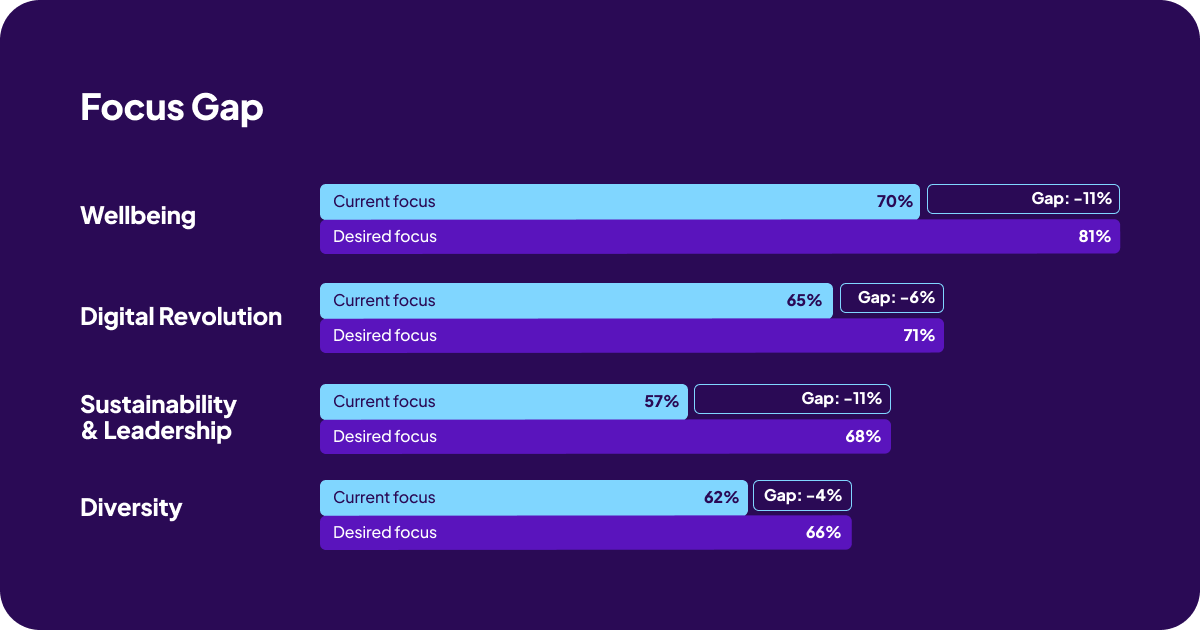
The real challenge for HR and L&D in 2026 isn't knowing what matters. It's building the systems, skills, and culture to deliver it: consistently, at scale, and for everyone.
Trend 1: Employee wellbeing is core to organisational success
What the data says about employee wellbeing in 2026
Wellbeing and learning are no longer separate.
In 2026, employees expect support for their mental fitness, resilience, and ability to handle pressure; because wellbeing is a performance driver, not just a health topic.
When people feel safe and supported, they learn faster, adapt to change, collaborate better, and stay longer.
Neglect wellbeing, and you risk absenteeism, low motivation, and turnover.
Alice Svoboda, Customer Success Manager at GoodHabitz, also echoed this sentiment:
“The role of a manager has changed so much in the last few years. If we think back to 10 years ago, our managers solely had to worry about the basics, such as admin, process, making sure people are in on time, and getting the work done. But now? People want a leader, a companion, a therapist. They’re the missing piece of the puzzle, when it comes to workplace safety and work happiness.”
According to Deloitte’s Global Human Capital Trends report, organisations that prioritise human sustainability outperform peers in long-term performance.
Wellbeing is a strategic capability, not a soft extra, that determines how successfully organisations can evolve.
Yet despite its strategic value, wellbeing isn’t evenly experienced in practice, especially during periods of change.
Our study highlights a critical gap.
Both managers and professionals feel cautious optimism (~40%), but professionals are more likely to feel anxious (20% vs 16%) or overwhelmed (13% vs 10%).
Managers with more control feel energised.
That emotional gap affects engagement, learning, and strategy execution.
Practical strategies for HR & L&D Leaders
Moving beyond traditional wellness programmes means weaving mental health strategies into the fabric of everyday work. In practice, that looks like:
- Integrating resilience and stress-management skills into learning journeys, not just standalone initiatives
- Equipping managers with tools to lead with empathy and create psychological safety
- Offering short, accessible micro-learning on mindset and emotional regulation that employees can use immediately
- Designing learning paths that develop technical skills and personal wellbeing simultaneously
Trend 2: Skills gaps and digital acceleration
Why digital skills matter for continuous learning
AI, automation, and digital transformation continue to reshape workplaces at record speed.
Employees don't just need technical knowledge; they need the confidence and adaptability to apply new tools effectively and responsibly.
The challenge is not only technological. It's behavioural.
The research confirms the scale of the problem:
- 71% of professionals say they would benefit from additional change-related training
- 31% of managers have never received formal change leadership training.
These figures represent millions of employees working in organisations where digital transformation is accelerating whilst the skills to navigate it remain unevenly distributed.
When people lack the skills to handle change, they hesitate. When they hesitate, transformation slows and competitive advantage erodes.
The World Economic Forum’s Future of Jobs Report 2025 finds that nearly 39% of workers’ core skill sets will be transformed by 2030.
But the challenge isn’t only that skills are missing.
It’s that organisations aren’t always aligned on which skills matter most. Managers say adaptability is the top skill their teams need (38%), while professionals prioritise communication (43%), higher than managers expect (35%).
Active listening matters to 35% of professionals, yet only 26% of managers see it as critical.
Without an understanding of what managers and professionals truly need, learning programs can miss the mark.
As David James, Chief Learning Officer at 360 Learning, explained in our podcast about identifying and closing skill gaps:
“Skills mapping has both short-term and long-term benefits for your employees. When you’ve completed the skills map, it’s the same data but in a different form that creates career paths. Leaders can become self-directed learners, and better understand, based on their current skillset, where they are in the organisation and where they could go.”
Key capabilities to build across all levels in 2026:
- AI literacy and responsible use of technology
- Analytical and strategic thinking
- Problem-solving in digital-first environments
- Adaptability during sustained uncertainty
How to integrate digital readiness across L&D
The most forward-looking L&D teams are shifting from reactive to proactive up-skilling, building capability before skill shortages emerge.
Micro-learning is particularly powerful here: short, focused content allows people to build competence in small steps without disrupting productivity and supports immediate application in the context of real work.
Digital readiness extends beyond technical skills; it involves emotional intelligence as well.
To build an AI-Literate workforce, focus on:
- Building digital confidence, not just hard skills
- Cultivating ethical awareness around AI and data
- Fostering curiosity and adaptability
The appetite is there. Organisations need to meet it, and to equip managers to guide their teams through digital change.
Structured tools like Goodlearn provide high-quality AI training that supports employees and managers alike, helping organisations measure progress and apply skills in real-world contexts.
Trend 3: Purpose, sustainability & values-based leadership
Sustainability has evolved well beyond environmental topics.
Employees today associate it with ethical behaviour, principled decision-making, and organisations that act in ways that genuinely benefit society.
This shift is reshaping what people want from their workplaces and moving up the L&D agenda as a result.
When people look for purpose at work, they also expect clarity on where the organisation is heading, especially during change.
As Hanan Challouki puts it in our podcast:
“One of the most courageous things that an inclusive leader can do is admit that they don’t have all the answers. They can say ‘I don’t have an answer to that, but let me check, research, and I’ll get back to you’.”
The research makes the stakes clear: lack of clear vision from upper management was cited as the single biggest barrier to successful change by both managers and professionals.
Without a compelling 'why', engagement falters and resistance increases, even when change initiatives are technically sound.
Purpose-driven leadership doesn't just inspire people. It equips them to navigate ambiguity. When employees connect their daily work to a larger goal, they're more adaptable, more motivated, and more resilient.
Practical strategies for HR & L&D Leaders
For HR and L&D, this means making purpose a learnable skill, not just a corporate value statement. Practical steps include:
- Training managers to communicate the 'why' behind change clearly and consistently
- Connecting organisational purpose to everyday tasks through learning and development
- Using real examples and scenarios rather than abstract principles
- Adding sustainability awareness to onboarding and skills journeys
Leadership isn't just a title; it's a skill anyone can develop.
GoodHabitz offers comprehensive leadership development content with courses like "The Art of Feedback," "Decision Styles," "Difficult Conversations," and "Leadership - Find Your Style."
Trend 4: Diversity & inclusion moves beyond training
Inclusive workplaces aren’t built through one-off workshops or tick-box initiatives.
They grow through continuous learning and everyday behaviours, from onboarding experiences to how managers navigate difficult conversations.
“At the heart of leadership development is this focus on inclusive leadership, because that is the vehicle for building trust in all employees. When leaders embrace inclusivity, employees feel safe sharing their ideas, asking questions, and contributing fully towards important initiatives.”
Christopher Pappas, Founder of eLearningIndustry.com.
And when that consistency is missing, the first sign is often distance between leaders and their teams.
One of the most persistent barriers to successful change is exactly that disconnect, cited by
- 12% of professionals
- 10% of managers
Inclusion, at its core, is about closing this gap.
Yet support isn’t distributed evenly: 66% of managers feel backed by HR and L&D during change, compared to just 34% of professionals, and nearly half of professionals feel unsupported altogether.
When access to development looks like this, an inclusive learning culture doesn’t fail because of intent; it fails because of infrastructure.
The Martin Braun Group Case Study illustrates this in practice.
Operating across 23 locations in 14 countries, the company focused on making learning accessible to all employees, including production-floor teams, turning diversity into a development advantage rather than a barrier.
Inclusion isn't just a learning topic. It's a condition for effective learning and for effective change. Explore more in our inclusive onboarding guide.
Practical strategies for HR & L&D Leaders
To make inclusion real and lasting in 2026:
- Move from annual training to continuous, behaviour-based development
- Focus on practical skills: empathetic and inclusive communication, cultural intelligence, psychological safety
- Provide managers with short, actionable learning rather than lengthy programmes around inclusive leadership
- Integrate inclusion into leadership journeys from day one
- Use digital learning to scale access regardless of role or seniority
The change management skills gap: the thread running through every trend
Across every trend, one challenge runs through them all: change management itself is uneven, misunderstood, and poorly distributed.
Organisations aren’t failing for lack of ambition; they’re failing to equip the people driving change with the skills to do it well.
Three gaps make the difference:
- Access gap. 73% of managers get ongoing leadership development. Only 50% of professionals have soft skills training, and 36% have none. The people closest to change are often the least prepared.
- Perception gap. 45% of managers think they involve teams early in change. Yet 44% of professionals say early involvement is their top request. And while 91% of managers track change success, only 17% of professionals know how.
- Communication gap. Nearly half of professionals, value communication most during change, but 40% of managers underestimate how much they need to improve. What leaders think they’re saying isn’t landing.
A practical example comes from Paragon, where leadership actively participated in communication sessions and involved employees in shaping solutions.
The result: employee satisfaction with communication exceeded benchmark levels showing that when leaders listen and engage, change lands.
The gaps are specific, measurable, and closeable. Organisations don't need to revolutionise how they work. They need to develop targeted, practical skills and extend them to everyone, not just managers.
What people leaders should do: a 2026 action framework
The picture is clear: it isn’t about more analysis, it’s about action.
Closing the gap between what leaders know and what actually happens at work is the real challenge.
- Assess readiness: map where your organisation stands. Which teams feel unsupported? Use engagement data, learning analytics, and direct feedback to see the gaps clearly.
- Prioritise impact: start with skills that drive transformation. Communication and change management deliver the biggest return, making all other initiatives stick.
- Role-specific journeys: managers and professionals experience change differently. Tailor learning programmes. For example, for managers on team involvement and clear communication, or professionals on resilience and adaptability. Shared frameworks keep everyone aligned.
- Extend access. don’t limit learning to managers. Make development available to all professionals. Inclusion isn’t optional: it accelerates change.
- Measure what matters: look beyond completion. Track skill application, confidence, and behaviour change. Make results visible, because most managers measure, but few professionals know. Closing that loop drives real progress.
HR & L&D tools and techniques for tracking impact
Tracking impact is where many L&D strategies falter.
And it’s not because organisations lack ambition, but because they measure the wrong things, or measure them invisibly.
The most effective approaches combine:
- Learning analytics dashboards that track engagement and application, not just completion
- Wellbeing pulse surveys and skills assessments to monitor capability gaps over time
- Feedback loops embedded directly into learning journeys
- Manager effectiveness scores that reflect team-level experience, not just self-reporting
The research shows that managers apply newly learned skills significantly faster than professionals (40% apply immediately vs 24% of professionals).
Understanding that hesitation gap, and designing practice opportunities that build confidence, is as important as the content itself.
Conclusion: preparing for 2026 with people-first learning
Across both studies, the message is consistent: organisations don't struggle because they lack awareness.
They struggle because they lack alignment, equitable access to skills, and the execution consistency to turn good intentions into embedded practice.
HR and L&D leaders who invest in wellbeing, digital readiness, purpose-driven leadership, inclusive culture, and change capability aren't just responding to trends.
They're building organisations genuinely equipped for what lies ahead. The research shows that when people feel supported, involved, and skilled, they don't just survive change.
They shape it.
The organisations that thrive in 2026 won't be defined by how often they transform, but by how well their people are equipped to drive that transformation.
People-first learning isn't an optional for the year ahead. It's the only one that lasts.
About this research
This research combines two European studies commissioned by GoodHabitz and conducted by Markteffect in 2025, providing a comprehensive view of workplace learning and change management trends.
One, from July 2025 surveyed 1,040 HR leaders, L&D professionals, and managers across the UK, Netherlands, Germany, Spain, and Belgium, exploring strategic L&D trends shaping 2026.
You can download the full whitepaper regarding the above piece of research here.
The other one, from December 2025 surveyed 2,867 professionals and 1,865 managers in organisations with 50+ employees across Belgium, Germany, Spain, France, Italy, Portugal, the UK, and the Netherlands, focusing on change management skills gaps and how employees and managers navigate organisational or team-level change.
Together, these studies highlight the critical skills, perceptions, and support gaps that will define learning, inclusion, and change management priorities in 2026.
FAQs
What are the top HR trends for 2026?
The four key trends are: employee wellbeing as a core priority, digital acceleration and the resulting skills gap, purpose-driven leadership with a focus on sustainability, and continuous behaviour-based inclusion. Across all of these, one challenge runs through them all: the ability to manage organisational change, a skill still unevenly developed in most workplaces.
How can HR leaders prepare for digital transformation?
Many employees still lack access to essential learning. HR leaders should prioritise accessible, on-demand digital learning for all, not just managers or technical teams. Focus on AI literacy, adaptability, and digital confidence, and treat them as ongoing habits rather than one-off programmes.
Why is employee wellbeing a priority?
Wellbeing drives performance. Professionals are more likely than managers to feel anxious or overwhelmed during change, which impacts learning, engagement, and transformation success. Embedding resilience and stress management into everyday development protects both people and organisational outcomes.
What skills will L&D teams need in 2026?
Core skills include communication, active listening, adaptability, problem-solving, and stress management. L&D teams must also design role-specific learning journeys, measure impact beyond completion rates, and ensure equal access for professionals and managers alike.
How can L&D leaders foster a more inclusive workplace?
Inclusion works when it’s continuous, not an annual event. Closing support gaps, ensuring professionals get as much guidance as managers, is itself an act of inclusion. Effective inclusion learning focuses on practical, behaviour-based skills like empathetic communication, cultural intelligence, and psychological safety, embedded into everyday leadership and team interactions.
How can organisations measure L&D impact in 2026?
Measurement should go beyond completion rates. Track skill application, confidence, and behaviour change using learning analytics, assessments, and feedback loops. Visibility matters too: it’s not just about measuring success, but making sure employees see how progress is tracked.
Roberta is a multilingual content manager with 15+ years of experience creating clear, engaging content that connects. Her goal is to help companies communicate complex topics in a more human, accessible way. An eager explorer and curious foodie, she spends her free time discovering new places and cultures, whether around the corner or on the other side of the world.
.webp)
