
Best AI Training for Employees (2026): Top Platforms Compared + How to Choose

AI training is no longer a question of whether to invest, but how.
Most organisations have already introduced AI tools into at least part of their business.
The challenge now is helping employees use those tools effectively, consistently, and responsibly.
With dozens of AI training platforms on the market, choosing the right solution isn't straightforward. Some focus on technical skills. Others prioritise AI literacy, compliance, or tool-specific training. Some work well for organisation-wide rollouts, while others are better suited to self-directed learning.
The question isn't simply which platform offers the most content. It's which one will help your employees build confidence, reduce risk, and apply AI effectively in their day-to-day work.
This guide compares the leading AI training platforms for employees in 2026, including their strengths, limitations, pricing models, and ideal use cases, so you can find the right fit for your organisation.
AI training platforms at a glance
Here's a quick overview of the platforms covered in this guide:
G2 ratings sourced from g2.com (2026). Pricing is custom quoted for all enterprise providers, contact directly for quotes.
What is AI training for employees?
AI training for employees is structured learning that helps people understand artificial intelligence: what it is, how it works, how to use it effectively, and how to use it safely.
It isn't about turning people into AI engineers.
It's about giving every member of your workforce the confidence and the judgement to work alongside AI tools in their daily roles.
At a minimum, employees who've completed good AI literacy training should be able to:
- Understand what AI tools can and can't do
- Write clear, effective prompts to get useful outputs
- Recognise when AI output might be unreliable or biased
- Use AI tools responsibly and in line with company policy
- Identify practical opportunities to use AI in their own role
The World Economic Forum's Future of Jobs Report 2025 found that 39% of workers' core skills are expected to change by 2030. AI literacy is rapidly becoming one of the foundational skills employers expect, not just in tech roles, but across every function.
AI training for non-technical employees vs technical AI training
This distinction matters more than it might seem, because choosing the wrong type of training is one of the most common and costly mistakes organisations make. Here's how the two differ:
AI literacy training
Who's it for?
All employees
What's the goal?
Daily usage and understanding of AI.
What are the typical topics?
Prompts, ethics, and risks.
What is the format?
Accessible, no prerequisites.
Technical AI training
Who's it for?
Specialists (developers, data teams)
What's the goal?
Building AI systems
What are the typical topics?
ML, Python, and model training.
What is the format?
Requires technical background
For most organisations, AI literacy training should be the priority.
Types of AI training for employees
Not all AI training looks the same. Understanding the different types helps you choose what's right for different parts of your organisation.
- AI literacy training is the foundation for all your employees. It should cover what AI is, how generative AI tools like ChatGPT work, and what responsible use of AI looks like, including spotting limitations and practical prompt-writing skills. This type of training is designed to be accessible, regardless of whether your employees have a technical background or not. This is where most organisations should start.
- Role-specific AI training goes beyond general literacy to show specific employees how AI applies to their work. HR teams learn how AI can support hiring workflows. Marketing teams explore AI-assisted content creation. Finance teams look at AI in data analysis. This layer builds confidence by connecting AI to real, recognisable tasks.
- Compliance and responsible AI training covers the legal, ethical, and governance dimensions of AI use. It's particularly important for regulated industries and organisations operating under frameworks like the EU AI Act, helping employees understand data privacy risks, bias, intellectual property considerations, and when not using AI.
- Tool-specific training is focused on specific platforms like Microsoft Copilot, ChatGPT, Google Gemini etc., rather than AI concepts more broadly. It's most useful when your organisation has committed to a particular tool and needs everyone to use it confidently and consistently.
How to choose the best AI training platform for your employees
The AI training market is growing fast, and many platforms now include some form of AI content. That doesn't mean they're all equal, or that any given platform is the right fit for your organisation.
Here's what matters when making your decision:
Relevance for non-technical employees
The most important question: will your frontline employees, HR team, finance staff, and managers actually be able to engage with this content?
Technical jargon, developer assumptions, or coding prerequisites will create immediate barriers. Look for platforms where AI literacy content is explicitly designed for non-technical audiences - and test it with a real sample of your learners before committing.
Coverage of responsible AI and risks
It's not enough to teach people how to use AI. They also need to understand the risks: hallucinations, bias, data privacy, intellectual property, and the limits of AI reliability. Platforms that skip this (- or treat it as an optional add-on) leave your organisation exposed. Responsible AI should be built into the curriculum, not bolted on.
Learning formats
Short, interactive content outperforms long video lectures for behaviour change. Look for microlearning modules, scenario-based exercises, quizzes, and practical application activities rather than passive watching. The best AI training helps employees try things, - not just understand them in theory.
Scalability
Can you roll this out across 500 people as easily as 50?
Does it work across different departments with different needs?
Platforms that require significant admin overhead or custom configuration for each rollout create friction that slows adoption. Look for structured learning paths that can be assigned across teams quickly.
Localisation and accessibility
For organisations operating across multiple countries or languages, localisation is non-negotiable. AI literacy training delivered only in English, or with cultural references that don't make sense to some nationalities, will fail to engage global teams. Check what languages are genuinely available - not just translated, but localised.
Integration and delivery
How does the training reach your employees?
Does it sit within your existing LMS or LXP, or does it require a separate login and platform?
Mobile access matters for deskless workers. SSO integration reduces friction. The easier your AI training is to access, the more people will actually complete it.
Content freshness
AI is moving faster than almost any other domain. A course written in early 2024 may already feel outdated.
Ask providers how often their AI content is updated, and whether they have a clear process for keeping pace with new tools, regulations, and capabilities. Static content is a liability in this space.
Cost and ROI
AI training ranges from free (Microsoft Learn) to premium subscription models.
The right question isn't just 'what does it cost?' - it's 'what does it cost per employee, and what will underinvestment actually cost us in lost productivity and AI misuse?'
The IDC estimates the global AI skills gap costs businesses $5.5 trillion in lost productivity. Budget accordingly.
Common mistakes when choosing AI training
Before making a shortlist of your top chosen AI training platforms, it's worth knowing where most organisations go wrong:
- Choosing technical training for non-technical teams: sending your marketing manager through a Python course doesn't build the AI literacy they need. Match the training type to the audience.
- Ignoring responsible AI: training that focuses only on productivity and capability without addressing ethics, risks, and limitations creates real compliance and reputational exposure.
- One-size-fits-all rollouts: a single training module can't serve your warehouse staff, your senior leadership, and your customer service team equally well. Role-relevant learning drives significantly better completion and application.
- Not aligning training to business goals: ‘we're doing AI training' isn't a strategy. The most effective programmes start with a clear question: what do we need our employees to be able to do differently as a result?
- Treating it as a one-time event: AI capabilities are evolving continuously. Training completed in 2024 needs refreshing in 2025. Look for providers that update content regularly and build for ongoing learning, not a single launch.
The organisations that benefit most from AI aren't those with the most sophisticated tools; they're those with the most confident, capable people using them.
Best AI training platforms for employees (2026)
Here's a detailed look at the leading platforms for AI literacy training - what they do well, where they fall short, and who they're best suited to.
1. GoodHabitz
Best for: AI literacy training that the whole workforce will actually engage with
GoodHabitz delivers engaging, human-centred AI literacy training through a rich content library of bite-sized, non-technical modules. The training is built to develop confidence across entire workforces, regardless of technical background. The core GoodHabitz library is where the learning happens: structured courses, short activities, and lessons that cover AI literacy, responsible AI, and the human skills employees need to work effectively alongside AI tools.
What sets GoodHabitz apart is the distinction between its content and its platform. The GoodHabitz library focuses on the theoretical and conceptual side, helping employees understand what AI is, how it works, what the risks are, and how to use it responsibly. Content is produced entirely in-house, ensuring consistent quality and tone, and is fully localised in 20+ languages.focuses on the theoretical and conceptual side, helping employees understand what AI is, how it works, what the risks are, and how to use it responsibly. Content is produced entirely in-house, ensuring consistent quality and tone, and is fully localised in 20+ languages.
GoodLearn bridges that learning to practice. Where the library provides the content, GoodLearn provides the structure, translating individual courses into guided development journeys, organisation-wide rollouts, and programmes designed to drive real behaviour change. It's the layer that moves employees from passive consumption to active, measurable development.
Its approach starts from a human perspective: how employees feel about AI, how they use it in daily work, and what they need to build genuine confidence.
Key features - GoodHabitz library:
- AI literacy content integrated within a broader human skills and digital skills library
- In-house content production ensuring consistent quality and tone
- Bite-sized, engaging formats: activities from 1–20 minutes, full courses, and structured lessons
- Psychometric assessment to match learners to the right content
- Fully localised in 20+ languages
- Flat-rate subscription; entire workforce access at one price
Key features - GoodLearn:
- Structured learning paths aligned to business goals
- Guided programmes that combine AI literacy with human skills
- Easy rollout of organisation-wide learning initiatives
- Clear progression tracking for teams and individuals
- Manager dashboards, analytics, and LMS/LXP integration
- Designed for behaviour change, not just content consumption
Content focus: AI literacy, responsible AI, digital confidence, and human skills that complement AI (critical thinking, adaptability, creativity)
Pros:
- Exceptionally engaging: completion rates significantly above industry average
- Clear separation between content depth (library) and structured activation (GoodLearn)
- Combines AI literacy with human skills in a practical, applied way
- Accessible and non-intimidating for non-technical employees
- Flat-rate pricing makes company-wide deployment predictable
Cons:
- Not suited to deep technical AI training (no ML or coding tracks)
- Narrower catalogue than aggregator platforms; depth over breadth by design
2. LinkedIn Learning
Best for: Self-directed AI training at scale
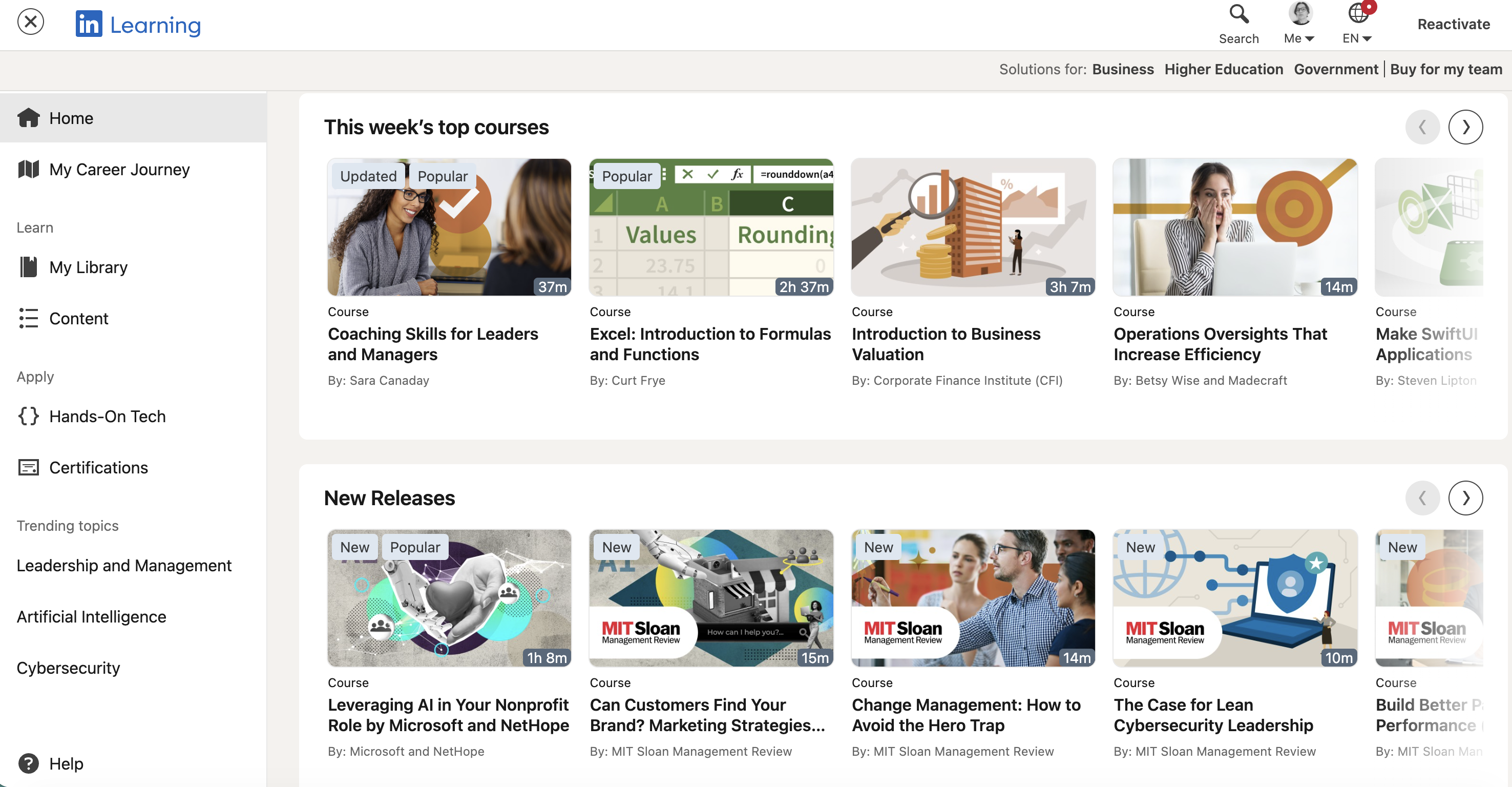
LinkedIn Learning excels in self-directed AI upskilling with its vast library of courses, including Microsoft-partnered generative AI paths and credentials that integrate directly with professional profiles, perfect for motivated teams seeking broad, familiar content.
Key features:
- 23,000+ courses across business, technology, and creative skills
- Dedicated AI literacy path: 'Career Essentials in Generative AI' (with Microsoft)
- AI-powered personalised course recommendations based on LinkedIn profile data
- Certificates that publish directly to LinkedIn profiles
- Available in 24 languages
- LMS and Microsoft Teams integration
Content focus: AI literacy, generative AI fundamentals, responsible AI, prompt engineering, Copilot tools, tech and business skills broadly
Pros:
- Extensive AI content library, consistently updated
- Microsoft partnership brings strong Copilot and responsible AI content
- Credentialing via LinkedIn profile adds employee motivation
- Familiar platform with high adoption in many organisations already
Cons:
- Some content is dated - AI moves fast, not all library content keeps pace
- Less suited to structured, manager-led programmes - designed for self-direction
- Search and discovery can feel overwhelming given the volume and learners might not know where to start
3. Coursera for Business
Best for: Credentialed AI upskilling with academic and industry depth
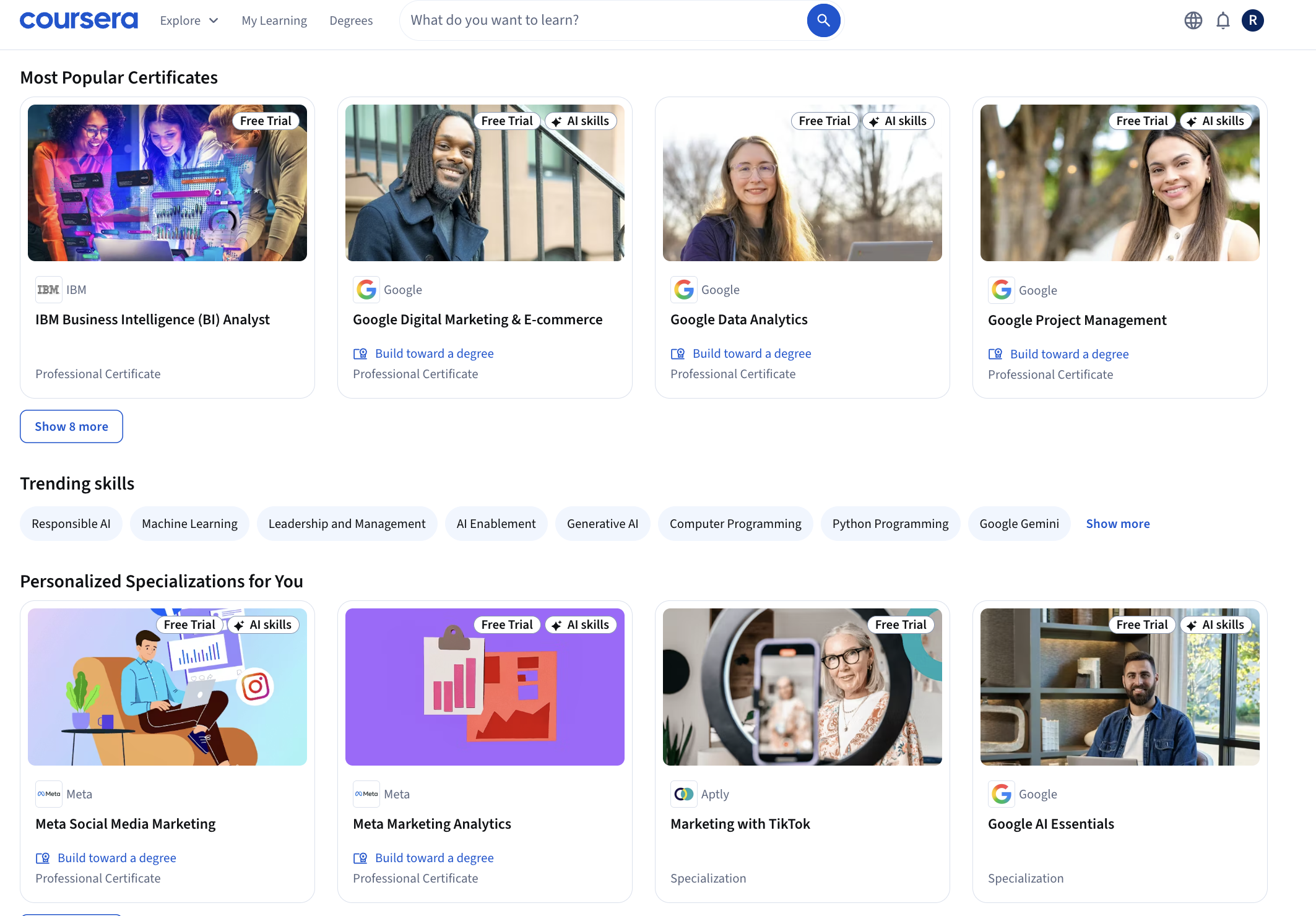
Coursera for Business excels in accredited AI training via university-backed courses like 'AI for Everyone' from DeepLearning.AI, offering rigorous yet accessible literacy for non-technical roles. It’s ideal for enterprises that value formal credentials and global recognition.
Key features:
- 'AI for Everyone' course (DeepLearning.AI / Andrew Ng) - specifically designed for non-technical employees
- 'AI Foundations for Everyone' (IBM) - business-focused AI literacy specialisation
- Accredited certificates from globally recognised institutions
- Guided projects and hands-on exercises
- Enterprise analytics: skills tracking by role, team, and department
- Content in 54+ languages
Content focus: AI literacy, generative AI applications, AI ethics and governance, data science and ML (for technical tracks)
Pros:
- Foundational AI literacy content that's genuinely accessible to non-technical learners
- Formal credentials add credibility and employee motivation
- Strong on AI ethics and responsible use
- Trusted globally by major organisations
Cons:
- Course lengths are long, so can be difficult to fit into busy schedules
- License restrictions make flexible deployment more complex
- Less effective for rapid, company-wide rollouts where completion speed matters
4. Udemy Business
Best for: Fast, role-specific AI upskilling across diverse teams
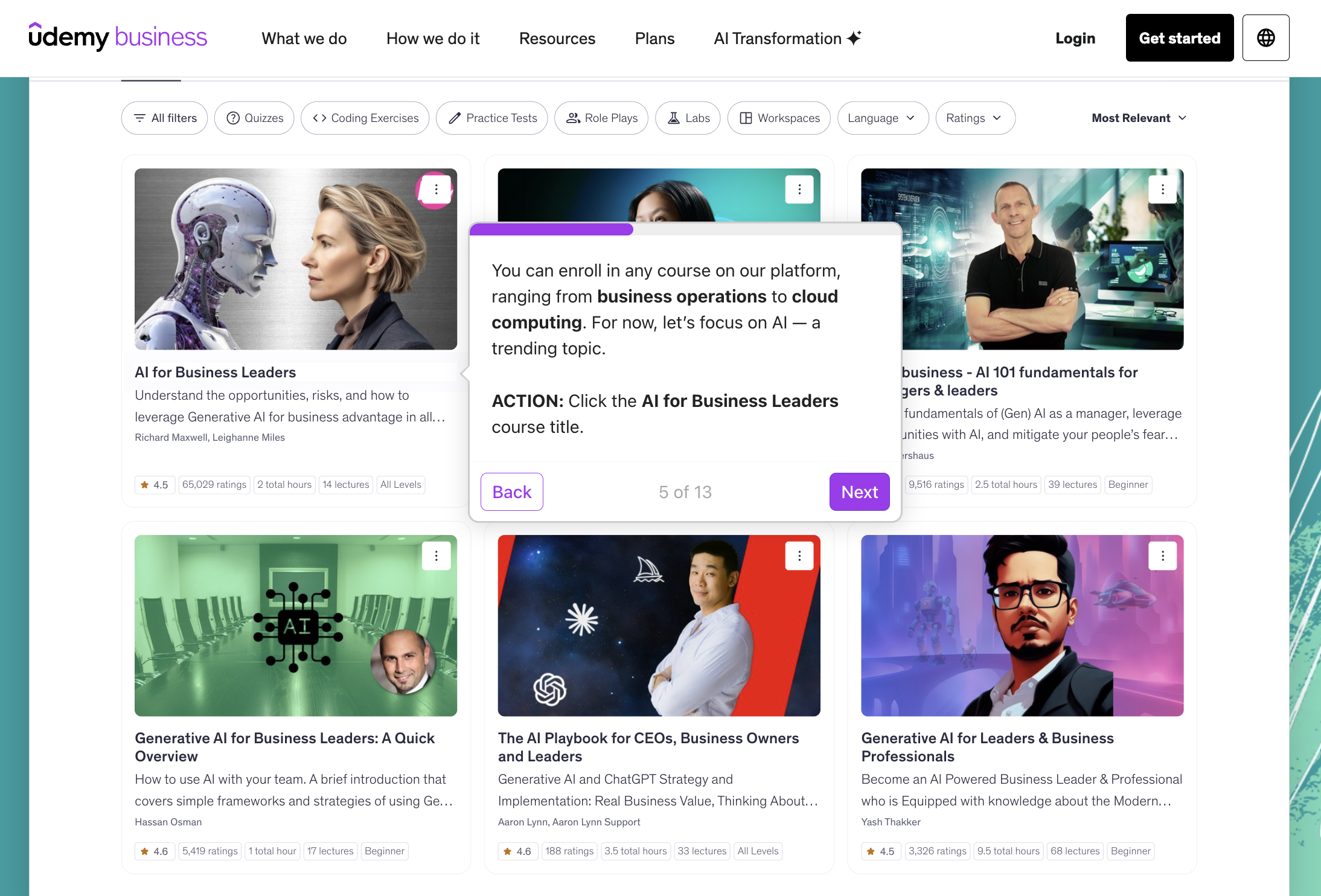
Udemy Business excels in role-specific AI training through curated starter paths for functions like HR, marketing, and finance, drawing from 16,000+ top-rated courses with rapid updates, suiting diverse teams needing flexible, practical upskilling.
Key features:
- AI Starter Paths: pre-built learning journeys by role (HR, marketing, finance, and more)
- GenAI fundamentals tracks for non-technical audiences, including AI ethics and responsible use
- 16,000+ curated top-rated courses (from a catalogue of 210,000+)
- Custom learning path creation for L&D teams
- Mobile and offline access
- LMS integration and analytics
Content focus: Generative AI fundamentals, ChatGPT and Copilot, AI for specific business functions, responsible AI
Pros:
- Role-specific AI Starter Paths make deployment fast and relevant for different teams
- Content refreshed rapidly to keep pace with new AI tools and capabilities
- Strong for organisations with diverse workforce needs
- Large library means niche use cases and tool-specific training are usually covered
Cons:
- Quality varies significantly beyond the curated set - curation by L&D teams is essential
- Less suited to structured, guided learning journeys without L&D active involvement
- Certificates have lower industry recognition than Coursera or LinkedIn Learning
5. Microsoft Learn / Copilot Skilling Centre
Best for: Organisations deploying Microsoft 365 Copilot and Microsoft AI tools
Microsoft Learn excels in free, tool-specific AI training focused on Copilot and Microsoft 365 productivity, with role-based paths and continuous updates.It’s perfect for organisations already in the Microsoft ecosystem seeking zero-cost, daily application skills.
Key features:
- Free, self-paced AI literacy modules on Microsoft Learn
- Copilot Skilling Centre: role-based training paths for Microsoft 365 Copilot
- 'Work Smarter with AI' course for non-technical employees - no prior AI background needed
- Webinar series and on-demand videos updated with new Copilot features
- Microsoft certifications available for those wanting formal credentials
Content focus: Microsoft Copilot, AI-assisted productivity, prompt writing, responsible AI in Microsoft tools
Pros:
- Free - significant cost advantage for Microsoft 365 users
- Directly tied to tools employees are already using daily
- Continuously updated as Microsoft Copilot features evolve
- No login friction for Microsoft 365 users
Cons:
- Primarily focused on Microsoft's own tools - limited for organisations using other AI platforms
- Self-directed model requires employee motivation; less suited to managed rollouts
- Not a substitute for broader AI literacy training covering tools, ethics, and workplace integration more widely
6. Go1
Best for: Enterprise-wide AI upskilling with vast content scale
Go1 excels in delivering comprehensive AI training through its expansive, curated library of over 10,000 AI-focused courses from top providers, making it ideal for large organisations rolling out literacy programs across diverse teams.
Key features:
- Role-based AI learning pathways for non-technical users, covering prompts, ethics, and practical applications.
- AI-powered content recommendations and automated curation for personalized employee journeys.
- Seamless integrations with existing LMS/LXP systems for easy deployment.
- Strong focus on compliance and responsible AI modules.
- Available in multiple languages with mobile access.
Content focus: Broad AI literacy, generative AI tools, workplace integration, skills frameworks complementing human abilities like critical thinking.
Pros:
- Vaste content breadth from partners like Coursera and LinkedIn, ensuring fresh, high-quality updates.
- Scalable analytics for tracking organization-wide adoption and ROI.
- Rapid enterprise rollouts with high completion rates.
Cons:
- Less emphasis on bespoke, in-house content, relies on aggregator model.
- May overwhelm smaller teams without dedicated L&D support for curation.
7. Docebo
Best for: Enterprises enabling AI training without heavy L&D reliance
Docebo delivers an AI-first learning management system that automates content creation and personalisation, ideal for organisations scaling AI literacy across non-technical roles like sales, HR, and operations.
Key features:
- AI tools for automatic course generation, quizzes, and scenario-based coaching from simple inputs.
- Virtual AI coaching and skills practice simulations for practical, risk-free AI application.
- Advanced analytics linking training to business outcomes, with role-based paths.
- Seamless LMS integrations and multilingual support for global teams.
- Focus on responsible AI, ethics, and prompt engineering in bite-sized formats.
Content focus: AI literacy fundamentals, generative AI ethics, workplace productivity boosts, and human-AI collaboration skills.
Pros:
- Empowers non-L&D staff to build custom AI training quickly, reducing bottlenecks.
- High scalability for large rollouts with completion tracking.
- Continuously updated AI features keep pace with tools like Copilot and emerging regs.
- Intuitive mobile access.
Cons:
- Higher setup complexity for smaller teams without IT support.
- Premium pricing reflects full LMS capabilities, less ideal for content-only needs.
How these AI training platforms compare
Depth vs accessibility
Coursera leads in credentials, GoodHabitz in engagement. Docebo adds scalable depth by letting teams create tailored AI content on-demand, complementing Go1's library scale.
Self-directed vs guided learning
Microsoft Learn fits self-starters; GoodHabitz, Udemy, Go1, and Docebo excel in managed programs, Docebo uniquely via AI automation for guided, SME-led paths.
Breadth vs focus
GoodHabitz ensures human-AI synergy; Docebo and Go1 handle diverse needs with creation tools and aggregation, covering compliance to role-specific literacy.
Human skills and AI together
One dimension that's easy to overlook: AI doesn't exist in isolation. The human skills that help employees use AI well ( eg.critical thinking, creativity, adaptability, communication, and more) are the same human skills that L&D teams have been investing in for years.
Platforms that treat AI literacy as a separate module miss this. Platforms that weave it into a broader human development offer (as GoodHabitz does) tend to produce better outcomes, because employees learn how to use AI and how to bring uniquely human judgement to the output.
AI literacy without human skills is just tool training. Human skills without AI literacy is just catching up. The organisations that thrive will build both together.
Final thoughts: choosing the best AI training for your employees
Choosing the right AI training platform isn't about finding the best product on the market; it's about finding the best fit for your organisation, your people, and the outcomes you're trying to drive.
The choice depends on where your employees are starting from, what you need them to be able to do differently, and how you plan to roll training out.
A few principles that consistently hold across the most effective AI training programmes:
- Start with literacy, not technology. Your employees need to understand AI before they can use it well. Foundational, accessible content comes first.
- Make responsible AI non-negotiable. Any training that doesn't cover risks, ethics, and limitations is incomplete. This isn't optional - it's essential.
- Match the format to the workforce. Short, engaging, role-relevant content outperforms long courses for broad rollouts. Reserve depth for the learners who need it.
- Plan for ongoing learning. AI is evolving too quickly for a single training initiative to stay current. Build for continuous development, not a one-time programme.
- Connect AI to human skills. The employees who get the most from AI are the ones with strong critical thinking, communication, and adaptability. Train both together.
The organisations pulling ahead in AI adoption aren't necessarily those with the most sophisticated tools. They're the ones that have invested in helping their people understand, use, and grow with those tools - confidently and responsibly.
Next step: building an AI-literate workforce
GoodHabitz helps organisations develop the AI literacy and human skills that employees need to work confidently alongside AI, in formats they'll actually enjoy. https://www.goodhabitz.com/free-trial, or https://www.goodhabitz.com/request-demo about building an AI literacy programme for your workforce.
Ready to build AI confidence across your organisation?
Frequently Asked Questions
How much does AI training for employees cost?
Costs vary significantly by platform and model. Microsoft Learn provides free, self-paced AI literacy modules for Microsoft 365 users. Subscription platforms like LinkedIn Learning and Udemy Business typically range from a few hundred to several hundred pounds or dollars per user per year, with enterprise pricing negotiated on contract. GoodHabitz offers flat-rate subscription pricing based on organisation size. Most enterprise providers will quote based on headcount and contract terms.
How long does AI training take?
This depends on the format and depth of the programme. A foundational AI literacy module can take as little as 30–60 minutes. A structured learning path covering AI fundamentals, responsible use, and practical applications might span 4–8 hours spread across several weeks. The most effective corporate AI training is designed for busy employees - bite-size, modular, and accessible in short sessions rather than requiring dedicated blocks of time.
Do employees need technical skills to benefit from AI training?
No. The AI literacy training covered in this guide is specifically designed for non-technical employees. No coding, data science background, or prior AI experience is required. The best programmes start from zero and build practical confidence through real-world examples and exercises - not theory or technical jargon.
How do I know if AI training is working?
Effective AI training should produce visible changes in how employees work, not just completion certificates. Look for: employees applying AI tools in their daily tasks, managers reporting more confident AI use across their teams, reduced errors and misuse of AI tools, and measurable productivity improvements in AI-assisted work. Platform analytics - completion rates, engagement data, skill assessments - give you the quantitative picture, but behavioural change is the real measure of success.
Roberta is a multilingual content manager with 15+ years of experience creating clear, engaging content that connects. Her goal is to help companies communicate complex topics in a more human, accessible way. An eager explorer and curious foodie, she spends her free time discovering new places and cultures, whether around the corner or on the other side of the world.