
Build vs Buy Training Content: How to Choose the Right Approach

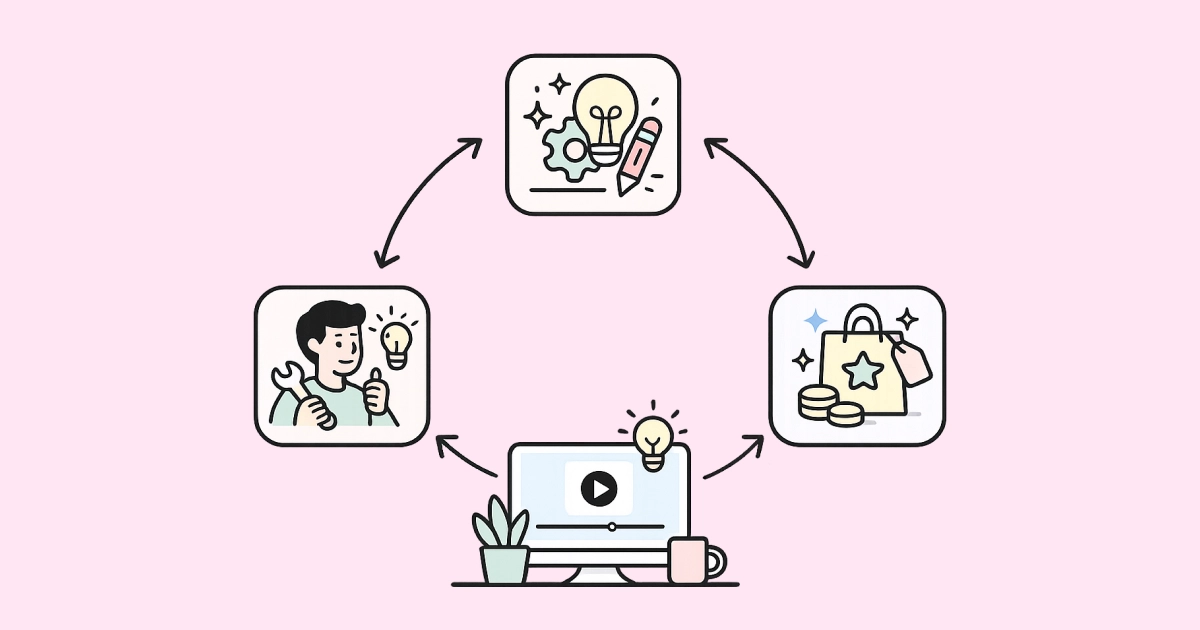
‘Should we build it ourselves or should we buy it?’ - It's a question every L&D team faces sooner or later.
And if only the answer were as simple as a coin toss.
Some learning content is so unique to your organisation that creating it yourself is the obvious choice. Other topics are already being taught brilliantly elsewhere, making it hard to justify starting from scratch.
That's why the build-versus-buy debate isn't really about choosing sides; it's about making smart decisions.
Knowing where your team's time is best spent. Understanding when customisation matters. And recognising when someone else has already done the hard work for you.
In practice, most organisations don't build everything. And they don't buy everything either.
They do both.
The real challenge is knowing when each approach makes the most sense.
And that’s exactly what we’ll cover in this guide.
Keep reading for all of the insights and information you need.
What Does “Building” vs “Buying” Training Content Really Mean?
Before diving into the decision framework, it is worth being clear about what each option involves, because both are broader than they might first appear.
Building Training Content
Building means creating learning content from scratch, either with your own team or through an external partner. This includes:
- Internal SMEs creating courses: subject matter experts recording videos, writing guides, or building structured learning with authoring tools.
- L&D teams developing content: instructional designers building interactive eLearning, scenario-based learning, or blended programmes.
- Custom eLearning agencies: outsourcing production to specialist providers who build to your brief.
Built content is most valuable for things topics or priorities unique to your organisation, such as your:
- Internal systems and tools
- Specific processes
- Regulatory requirements
- Culture
No external provider will ever know your CRM system or your onboarding journey better than you do.
The catch? Building takes time, often weeks or months. It requires expertise to do well. And once built, it needs to be maintained and updated as things change. These hidden costs are consistently underestimated.
Buying Training Content
Buying means licensing ready-made courses from an external content provider. This could be:
- Off-the-shelf course libraries: subscriptions to platforms offering hundreds or thousands of courses on broad topics.
- Topic-specific content packs: focused collections on subjects like compliance, leadership, or digital skills.
- Curated learning paths: pre-built programmes that combine multiple courses into a structured journey.
Bought content works particularly well for skills that are universal across industries and roles: communication, time management, leadership, feedback, resilience.
These are topics where the core principles do not change depending on where you work, and where professionally produced content can often deliver a level of instructional design and production quality that many L&D teams would struggle to match internally.
This also includes emerging areas like AI literacy. Want to stay ahead of the curve? Check out our guide to the Best AI training for employees.
However, the key risk is relevance.
When content feels too generic or disconnected from the organisation’s reality, learner engagement drops quickly.
Success depends not only on the quality of the content itself, but also on how effectively it is contextualised within your organisation.
Platforms such as GoodHabitz illustrate this approach: providing a broad range of engaging, professionally designed courses on soft skills, leadership, digital skills, and wellbeing, built to be immediately applicable across different roles, teams, and industries.
Why L&D Teams Find This Decision Difficult
If the choice were straightforward, you would not need a framework. The reality is that most L&D teams are working under a familiar set of pressures:
- Pressure to deliver training quickly, often faster than it can realistically be built.
- Limited internal resources; not every team has instructional designers or content production capacity.
- Learners who expect training that is relevant, engaging, and specific to their situation.
- An overwhelming external market, with hundreds of providers all making similar promises.
When everything starts to look the same, it helps to have a clear way to compare. Our guide on How to choose an eLearning content provider for your LMS can help you build a practical checklist.
Without that clarity, many teams default to one approach or the other, either building everything in-house (slow and expensive) or buying broadly (risking low engagement), without a clear strategy for when each makes sense.
That's why a little structure goes a long way.
Build vs Buy: A Practical Decision Framework
The good news?
You do not have to pick a side.
The best approach depends on the type of training you are dealing with.
By working through these four questions, you can make more confident decisions about what to build, what to buy, and where your team's time will have the biggest impact.
1. How Unique Is the Content?
This is the question that usually makes the biggest difference.
Content that is highly specific to your organisation: your tools, your processes, your internal systems can only come from you.
No external provider has that knowledge, and trying to approximate it with generic content is usually a poor use of budget.
Broadly applicable content, on the other hand, is exactly where external providers excel. They have invested in research, instructional design, and production quality that most L&D teams cannot match internally.
Ask yourself: could this content, with minimal adaptation, be used by any organisation in our industry?
If yes, buy it. If it requires deep knowledge of how your organisation specifically operates, build it.
- Build if: the content is about your internal systems, specific compliance requirements, proprietary processes, or unique ways of working.
- Buy if: the content covers feedback skills, leadership principles, communication, or any broadly applicable professional skill.
2. How Quickly Do You Need It?
Sometimes, speed changes the equation in fast-growing organisations, particularly when a training need emerges suddenly: a new system rollout, a regulatory change, or rapid headcount growth.
Building content from scratch, even with the best tools available, takes time. Scoping, writing, producing, reviewing, and publishing a quality course typically takes weeks at minimum, and months for complex programmes. If you need something live next week, building from scratch may not be the most practical option.
Buying, by contrast, can be done in days. A good content library means you can identify, curate, and assign relevant training to hundreds of people within hours.
Speed is not just about urgency; it is also about opportunity cost. Every week your L&D team spends building a course on communication skills is a week they are not spending on strategic work only they can do.
- Build if: you are planning ahead, the content is genuinely unique, and you have the time and capacity to do it well.
- Buy if: the need is urgent, the topic is broadly applicable, or you need to scale quickly across a large number of learners.
3. Do You Have the Internal Expertise?
Building effective training content relies on two different types of expertise: subject matter expertise (knowing the content) and instructional design expertise (knowing how to turn that content into learning that sticks).
Most organisations already have plenty of deep expertise in-house. The challenge is that knowing something well doesn’t automatically mean you can turn it into a learning experience that works. Without structure, even the most valuable insight can quickly become an information dump - think long, unstructured videos or slide decks that don’t quite land.
And this is where things get interesting. The question isn’t whether your experts are good enough; it’s whether they’re supported well enough to translate knowledge into learning design.
With the right setup, subject matter experts don’t need to become instructional designers. Tools like GoodHabitz Experts help bridge that gap, giving structure to raw expertise and using AI to support flow, format, and learning logic, so knowledge becomes something people can learn from, not just consume.
Our guide on how AI can help you create training materials shows how AI can speed up and simplify the process of turning expertise into learning content.
- Build if: you have instructional designers in place, or tools and frameworks that help SMEs structure their knowledge into effective learning experiences.
- Buy if: your SMEs are time-poor, you lack instructional design capacity, or you don’t yet have tools that make content creation accessible beyond L&D specialists.
4. What Is the True Cost Over Time?
This is where many teams underestimate building. The upfront cost of creating content is obvious: time, tools, and expertise. But the ongoing cost is where building becomes expensive in ways that are easy to miss.
Content needs to be maintained. Products change. Processes are updated. Regulations evolve. Every piece of content you build is a commitment to keep it current, and outdated training is not just useless, it can actively mislead learners.
Off-the-shelf content providers handle their own updates. You pay a subscription or licence fee, and the content stays up to date. For topic areas that do not change based on your internal context, like soft skills, leadership, digital literacy, this is often a better long-term investment than building.
- Build if: you have the capacity and commitment to maintain content over time, and the specificity justifies the ongoing investment.
- Buy if: you want to minimise maintenance burden, or the topic area is one where an external provider's content will stay reliably current.
Build vs Buy at a Glance
Use this as a prompt for discussion, not a definitive scorecard. Most decisions will involve trade-offs across multiple rows.
Real-World Scenarios: When to Build vs Buy
Decision frameworks are most useful when you can see them applied to situations that feel familiar. Here are four scenarios that reflect the choices L&D teams face regularly.
Scenario 1: Scaling Soft Skills Across the Organisation
Best choice: Buy
A mid-sized professional services firm is scaling quickly and needs consistent communication and influencing skills across multiple countries and teams. The L&D team is lean, and there’s pressure to move fast.
This is a classic “buy” situation. Soft skills like communication and influencing are well-established, widely researched, and already covered by high-quality learning content. Rebuilding them internally rarely adds value; it mainly adds time.
The real opportunity here isn’t content creation. It’s curation, localisation, and activation: choosing the right learning, making it relevant, and driving adoption across the organisation.
Scenario 2: Training on Internal Systems or Processes
Best choice: Build
A logistics company has rolled out a new internal routing system. Every operations employee needs to understand how to use it in their daily work.
This is clearly internal territory. No external provider can reflect the specifics of the system or how the organisation uses it in practice. The content needs to be accurate, practical, and tightly aligned with internal workflows.
Here, the challenge isn’t expertise: it’s turning that expertise into clear, structured learning that people can follow and apply.
Scenario 3: Leadership Development for Emerging Managers
Best choice: Mostly buy, with light contextualisation
A tech company is developing a programme for first-time managers. Core topics include feedback, one-on-ones, performance conversations, and team development. At the same time, the organisation has its own leadership framework and principles it wants to embed.
This is where a blended approach works best.
The foundational leadership skills already exist in strong external learning content; there’s no need to reinvent them.
But the organisation-specific layer does need to be built internally, so it reflects how leadership is defined and practised in that context.
The result is a programme that combines speed and quality from external content with relevance and alignment from internal input.
Scenario 4: Compliance Training with Internal Nuances
Best choice: Hybrid
A financial services organisation needs to deliver annual compliance training on topics like data protection, anti-money laundering, and conflicts of interest.
The core regulations are standard across the industry, making them well suited to external content. But compliance only becomes meaningful when employees understand how it applies inside their organisation.
That’s where internal input matters: policies, escalation paths, and real internal procedures need to sit alongside the regulatory foundation.
A hybrid approach ensures both accuracy and relevance; standard knowledge where it already exists, and tailored context where it doesn’t.
Why a Hybrid Strategy Usually Wins
If there is a single insight that defines how effective L&D teams operate today, it is this: the question is not whether to build or buy.
It is what to build, what to buy, and how to make those decisions strategically rather than by default.
Modern learning teams spend less time creating content for the sake of it and more time connecting people with the right learning at the right time. That means investing internal effort where it adds unique value and using external content to scale quickly.
The principle is surprisingly simple:
- Buy for breadth: use external content to cover the wide range of skills and topics your people need that are not specific to your organisation.
- Build for specificity: invest internal effort in the content that only you can create: the knowledge, processes, and context that define how your organisation works.
- Avoid reinventing the wheel: Every hour spent recreating content that already exists is an hour not spent on the work that truly needs your expertise.
Great L&D teams are not winning because they create more content. They're winning because they know when not to.
How to Implement a Build vs Buy Strategy
Knowing the framework is one thing. Here is a straightforward process for putting it into practice across your organisation's learning needs.
1. Audit your existing training content
Start by mapping what you already have. Which courses are available to learners? What is being used, and what is sitting untouched? You may find you are paying for external content that overlaps with things you have built internally, or building content that already exists in your subscriptions.
2. Categorise each content area as “build” or “buy”
Apply the four-criteria framework to each training topic. Is it highly specific to your organisation? Does it need to be live quickly? Do you have the tools and expertise to build it well? What does long-term maintenance look like? Use these questions to make a deliberate categorisation rather than defaulting to habit.
3. Identify the gaps
Where are the training needs currently not met by either your built content or your bought content? Which gaps are most urgent, and which would have the highest impact if addressed?
4. Prioritise based on impact and urgency
Not everything can be addressed at once. Prioritise gaps across two dimensions: how important is this training to your organisation right now, and how quickly does it need to exist?
5. Assign ownership
For content you are going to build, be clear about who is responsible: which SMEs, which L&D team members, which tools they will use. For content you are going to buy, be clear about which provider, which procurement process, and how you will contextualise it for your audience.
If you’d like a practical walkthrough of the building side in more detail, our guide on How to create internal training explores how to structure and develop effective in-house learning.
6. Review regularly
A build vs buy strategy is not something you decide once and forget. It should evolve with your organisation, so revisit your choices at least once a year, or whenever priorities shift.
The most effective setups usually combine both: easy access to strong external content for common skills, and a simple way for internal experts to turn their knowledge into structured learning without friction.
That balance is what keeps learning both scalable and relevant.
Conclusion: Do Not Choose a Side; Choose the Right Mix
The build vs buy debate is not a competition with a winner. Both approaches have an important role to play in a well-functioning L&D strategy, and teams that try to do everything one way or the other tend to either overstretch themselves building content that already exists or frustrate learners with generic training that does not reflect their reality.
Build versus buy is the wrong question. The better question is: where does your team's time create the most value?
That means being strategic about where you invest your build capacity, focusing on the proprietary, specific, high-value knowledge that only your organisation can create. And it means being smart about where you buy, selecting content that is genuinely high quality and relevant, rather than just ticking a box.
When you get that balance right, your L&D team can move faster, reach more learners, and focus its energy where it genuinely makes a difference.
If you want to explore how this looks in practice, GoodHabitz and Experts support both sides of the equation: scalable, ready-to-use learning for common skills, and a simple way for subject matter experts to turn internal knowledge into structured training.
FAQ: Build vs Buy Training Content
Is it always cheaper to buy training content than to build it?
In most cases, yes - particularly when you factor in the true cost of building. Direct costs include your team's time, authoring tools, and potentially external production support. Hidden costs include content maintenance, updates, and the opportunity cost of your L&D team's attention. Off-the-shelf providers handle their own updates and quality assurance, which significantly reduces your ongoing investment. That said, for highly specific or proprietary training, buying is not an option; no external provider can create content about your internal systems or processes.
What types of training are best suited to buying off the shelf?
Off-the-shelf content works best for broad, universally applicable skills: communication, leadership, time management, wellbeing, digital literacy, and standard compliance areas. These are subjects where the core principles apply across industries and organisations, and where external providers often invest in instructional design and production quality that is difficult to replicate internally.
What types of training always need to be built internally?
Any training that requires knowledge specific to your organisation. This includes training on your internal tools and systems, your proprietary processes, your specific ways of working, your internal policies, and your organisational culture. No external provider has access to this knowledge, and trying to approximate it with generic content will typically produce training that feels irrelevant to learners.
Can I use both strategies at the same time?
Absolutely, and most effective L&D teams do. The hybrid approach involves buying external content to cover broad skill areas and scale quickly, whilst building internal content for the proprietary knowledge and context that only your organisation can provide. The key is being deliberate about which approach you use for each training need, rather than defaulting to one or the other out of habit.
What is the biggest mistake L&D teams make when they decide to build?
Underestimating the total commitment. Building a course is not a one-time production task; it is a long-term commitment to keep that content current, accurate, and relevant as your organisation changes. Teams often focus on the upfront effort and overlook the ongoing maintenance burden. Before committing to building, ask not just “can we create this?” but “can we maintain it?”
How do I know if our team has the capability to build effectively?
Building effectively requires both subject matter expertise (people who know the content deeply) and instructional design capability (people or tools that can turn that knowledge into effective learning). If your team's built content tends to be long documents, unstructured videos, or dense slide decks, that is a signal that the build capability needs investment, whether through training, better authoring tools, or external support.
Roberta is a multilingual content manager with 15+ years of experience creating clear, engaging content that connects. Her goal is to help companies communicate complex topics in a more human, accessible way. An eager explorer and curious foodie, she spends her free time discovering new places and cultures, whether around the corner or on the other side of the world.