The SME training playbook: how to turn expert knowledge into high quality training

Think about the last time your organisation rolled out a new policy.
There was probably a PDF. Maybe an email asking everyone to confirm they'd read it. Perhaps it was on an intranet page that nobody could find.
And a few weeks later?
The same questions started landing in your inbox, and it’s the ones the policy was meant to answer.
Or think about that colleague who left last year. The one who just knew how things worked. The unique client quirks only they understood, the tool that only they knew how to use, their shortcut that saved three hours every Friday.
Their handover covered the basics.
The rest of their knowledge walked out the door.
This isn’t unusual. It’s how internal knowledge works in most organisations:
- fragmented,
- perishable,
- hard to turn into training people use and apply.
Knowing how to create internal training that is consistent, fast, and effective is one of the biggest challenges for L&D and HR teams today.
Until recently, there hasn’t been a real solution - one that can capture expertise, structure it for learning, and make it accessible across the organisation.
GoodHabitz Experts changes that.
Built on the same proven educational framework that powers GoodHabitz's own content library, Experts is an AI-powered platform that helps L&D teams turn policies, processes, and internal expertise into engaging training in under 30 minutes - no design skills, no agencies, no lengthy production cycles.
This article breaks down exactly:
- Why the process of internal knowledge sharing is currently broken
- How GoodHabitz Experts works
- Why it's different from the generic authoring tools and AI-assisted alternatives you may already have tried.
The problem every L&D team knows but rarely solves
The challenge of internal knowledge transfer isn't new, and most organisations have tried to solve it before, usually with mixed results.
Internal knowledge is fragmented by default
In most organisations, critical expertise is scattered across people's heads, shared drives, and informal conversations.
When new policies, training updates, or onboarding programmes are needed, L&D teams scramble to consolidate everything - and often fail.
The result is predictable: document dumps, outdated slide decks, and PDFs that get emailed for acknowledgement but rarely read.
Training ticks the compliance box but doesn't transfer real knowledge.
According to Gartner, 47% of digital workers struggle to find the information they need to do their jobs.
And even when they find it, applying it effectively is another challenge. Why? Because documents explain what a policy says, but not how experienced employees make it work in reality.
47% of digital workers struggle to find the information they need at work. Source - Gartner
The result is predictable. Teams develop their own interpretations. Processes drift across regions.
The same questions keep landing in HR inboxes months after a policy has gone out.
Keeping training current is unsustainable
Creating training is just the first step.
The real challenge is keeping it up to date and relevant - and in most organisations, that rarely happens.
When a policy changes or a process shifts, the cycle starts all over again: drafts, reviews, approvals.
L&D becomes the bottleneck, and updates get delayed. Meanwhile, employees do what's fastest: ask a colleague, rely on hearsay, or try to remember.
This "knowledge friction" is costly. APQC research shows that workers lose 8.2 hours per week searching for information, recreating existing work, or tracking down the right person to ask - more than a full workday every week, per person.
8.2 hours per week lost by the average knowledge worker to knowledge friction - searching, recreating, and chasing answers. Source: APQC
Asana's Anatomy of Work Index, which surveyed over 10,000 knowledge workers, puts it even more starkly: 60% of working time is spent on 'work for the sake of work'.
It’s the activities like searching for information, switching between tools, and chasing status updates - rather than the skilled work people were hired to do.
60% of working time is spent on 'work for the sake of work' - searching, chasing, switching - rather than skilled work.
Source: Asana Anatomy of Work
Research from infoMENTUM carried out by Censuswide suggests that UK businesses lose an estimated £15,000 per employee each year because of poor document management and knowledge inefficiencies.
That figure isn't abstract.
It's the hours spent recreating a document that already exists.
It’s the new starter who's still asking basic questions months after they completed their onboarding.
It’s the process that breaks every time the one person who understands it is on holiday.
It's the price of not having a system, and it renews itself every year.
£15,000 per employee, per year lost due to document and knowledge inefficiencies.
Source: Censuswide
Traditional tools can't capture expertise
If you've tried training solutions before, you know the pattern.
Authoring tools can create polished content, but to get real value, you often need instructional design skills, dedicated licenses, and hours of structuring content from scratch.
Newer AI-assisted tools promise speed but only if you already have everything prepared.
They generate content, not insights, and can't uncover the tacit knowledge that lives in employees' heads.
No guidance from subject matter experts, no real understanding, and no learning design behind the output.
Agencies are another option, but they're expensive, slow, and create dependency.
Customer research shows a single bespoke training build can take weeks and cost up to €20,000. By the time it's delivered, the process it covers may have already changed.
Up to €20,000 and several weeks to build a single piece of bespoke training using traditional methods.
GoodHabitz Experts pilot data
The issue isn't a shortage of tools.
It's that none of them are built to do the hardest part: take what experienced people know and turn it into training that someone else can learn.
Introducing GoodHabitz Experts
GoodHabitz Experts is an AI-powered platform that helps L&D teams turn internal knowledge - captured from subject matter experts, documents, and policies - into structured, ready-to-publish training in under 30 minutes.
No instructional design skills. No external agencies. No long production cycles.
Built on the same proven learning methodology behind the GoodHabitz content library, Experts creates training designed for real understanding and behaviour change, not just information sharing.
It brings that same trusted quality to the internal knowledge your organisation relies on every day.
Subject matter experts don't need to write or design anything. They simply answer guided questions.
Experts turns their input into a complete, well-structured lesson ready to review, publish, and share.
How GoodHabitz Experts works: in three steps
The Experts workflow is designed to remove every barrier between expertise and training. Here's how it works in practice.
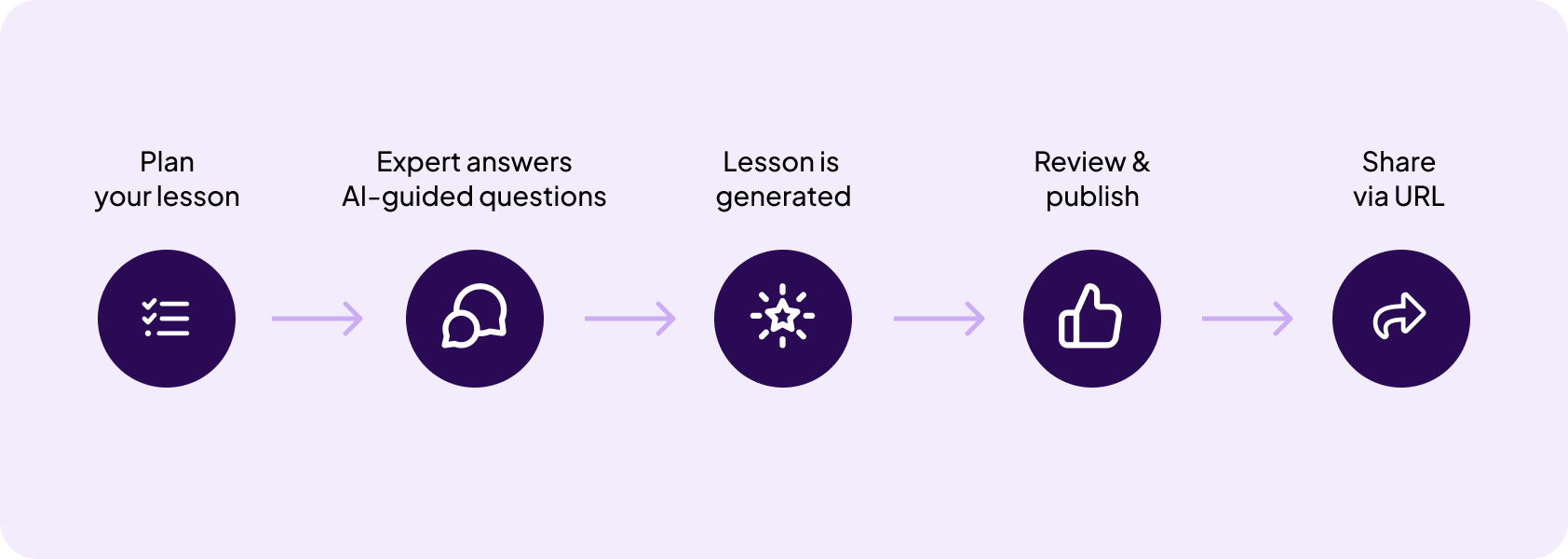
Step 1 - Plan your lesson with confidence
Start by pinpointing what truly needs to be captured:
- A policy that must be consistent across teams
- A process currently known by only one person
- Critical know-how at risk due to role changes or retirements
The AI guides the planning process, so you don't have to start from scratch:
- Define the learning objective
- Identify the right subject matter expert
- Shape the lesson structure before content capture
- No prior training design experience required
Your L&D team stays in control, while the platform ensures the lesson is well-structured and ready for content creation.
Step 2 - Capture expertise through guided interviews
This is where Experts truly stands apart. The subject matter expert (SME) doesn't need to write, design, or structure anything. Instead, they participate in an AI-guided interview:
- A structured conversation that surfaces knowledge, judgment, and practical insight
- Focused on how work actually gets done, not just what the policy says
Step 3 - Turn insights into learning
Once the expert's knowledge is captured, Experts automatically structures it into a lesson:
- Organised content: key points, examples, and step-by-step guidance are laid out logically
- Engaging formats: including videos and dilemma stories, in the familiar GoodHabitz learning design
- Consistency guaranteed: ensures every learner receives the same high-quality instruction
The L&D team remains in control, reviewing and refining the lesson before it goes live. No instructional design expertise is needed - the platform handles the heavy lifting while your team ensures accuracy and relevance.
Outcome: learners get content that's practical, up-to-date, and immediately applicable - not just a PDF or slide deck.
Workflow at a glance:
Four ways L&D teams use GoodHabitz Experts
GoodHabitz Experts is built around four core use cases, each tackling a different dimension of the internal knowledge problem.
So, without further ado, let’s dive into it.
Use Case 1 - Policy training
The problem: policies often fail because distributing information isn't the same as transferring understanding. A PDF or slide deck might tick the compliance box, but it doesn't change behaviour. HR ends up answering the same questions for months, and compliance drift quietly sets in.
The data: GoodHabitz research across 4,733 European professionals found:
- 91% of managers believe their organisation measures change success
- Only 17% of employees know what that success looks like
The solution: with Experts, policy documents become a structured, engaging lesson in under 30 minutes. Lessons update instantly when policies change, without waiting for approvals or new production cycles.
91% of managers measure change success. Only 17% of employees know how.
The gap between leadership intent and employee experience - GoodHabitz Change Management Research, 2025 (n=4,733)
Use Case 2 - Process enablement
The problem: critical process knowledge often lives in the heads of a few people. When they are busy or leave, processes slow down or break entirely. Handovers and shadowing rarely capture the nuances, exceptions, and decision-making know-how that make the process work.
The data: according to the World Economic Forum’s Future of Jobs Report 2025, 63% of employers say skills gaps are the biggest barrier to business transformation over the 2025–2030 period, highlighting how critical it is to capture process know-how before it slows execution.
The solution: Experts captures steps, edge cases, and practical judgment via AI-guided interviews. The result: one source of truth, replicable lessons, consistent execution, and faster ramp-up for anyone stepping into a new role.
Use Case 3 - Internal expertise capture
The problem: when experienced employees leave, years of know-how vanish - from client nuances to operational shortcuts. Most organisations respond reactively with rushed handovers or informal sessions, which rarely transfer real understanding.
The data: by 2050, 29% of Europe's population will be 65 or older, according to Eurostat - accelerating retirement-driven knowledge loss across sectors including manufacturing, healthcare, and professional services.
The solution: Experts makes capturing expertise easy. AI-guided interviews with outgoing employees produce lessons built for understanding and recall, not just transcripts. New hires get up to speed faster, and productivity dips during transitions are smaller and shorter.
Nearly 1 in 3 Europeans will be 65+ by 2050 - accelerating retirement-driven knowledge loss across major sectors.
Source: Eurostat
Use Case 4 - Onboarding
The problem: onboarding is inconsistent. It depends on who's available, their memory, and ad hoc shadowing. Outdated slides or informal coaching result in a disjointed learning experience.
The data: Randstad research found that Gen Z employees - now the fastest-growing segment of the workforce - stay in roles for an average of just 1.1 years during the early stages of their careers. Every new hire is essentially a new onboarding cycle.
The solution: Experts captures knowledge from top performers and turns it into replicable onboarding lessons. Every new hire receives the same high-quality knowledge transfer, regardless of their manager, cohort, or office location. Outcomes include faster time to productivity and consistent, measurable onboarding experiences.
1.1 years average job tenure for Gen Z employees in the early stages of their careers. Every new hire is an onboarding event.
Source: Randstad
What makes GoodHabitz Experts different
AI content tools are everywhere.
But most are built to generate content, not to create learning. That's where Experts stands apart.
Educationally sound lessons - not just AI-generated content
Most AI tools generate text.
GoodHabitz Experts generates training built on the same proven learning design methodology that structures every GoodHabitz lesson for comprehension, recall, and behaviour change.
That distinction matters more than it might initially seem.
Information transfer and learning aren't the same thing.
A lesson with clear objectives, a logical sequence, and built-in moments for application is significantly more effective than a well-written document covering the same ground.
GoodHabitz Experts lessons are short, bite-sized, and designed to fit naturally into busy workdays - learning that works around the flow of work, not against it.
Built to extract expertise, not assume it
Other tools expect you to arrive with content already organised, structured, and ready to go.
They're production tools. Experts is an extraction tool.
The AI-guided interview is designed to draw out what an expert knows - the contextual judgement, the practical shortcuts, the instincts built through experience - through structured questions.
The expert doesn't need to write, prepare, or organise anything beforehand.
They simply answer. The platform structures the output into training.
That's the core difference.
Guided input replaces long workshops, time-consuming handovers, and the instructional design bottleneck.
The GoodHabitz quality standard - now for your internal content
This is Experts' strongest differentiator.
Every lesson is built on a proven educational framework designed for real understanding and behaviour change, not just information transfer.
Custom training created with Experts carries the same credibility and learning design principles that make GoodHabitz content effective.
In other words? There’s a clear structure, measurable outcomes, and a focus on applying knowledge in practice.
With Experts, you're not choosing a generic AI tool and hoping for the best. You're choosing a system built to turn expertise into training that truly works.
Speed and control without sacrificing quality
Lessons are created and updated in under 30 minutes.
The L&D team keeps publishing control - reviewing and approving every lesson before it goes live.
No dependency on agencies or scarce instructional design resources, with an external production cycle.
The platform supports multiple languages, unlimited authors, and unlimited learners.
Learners access training via a simple shared URL - no app needed.
And when something changes, the lesson is updated in the platform directly, without starting from scratch.
Who can use GoodHabitz Experts?
Many organisations worry that AI-powered tools require specialist skills. Experts removes that barrier entirely.
- L&D teams act as administrators: they set up lessons, review AI-generated content, and publish. The platform handles the instructional structure - no authoring expertise needed.
- Subject matter experts provide the knowledge: guided through a short AI interview, they upload relevant documents and answer questions. No writing or teaching experience required.
María Rosales, Product Manager at GoodHabitz, said:
“Internal training has traditionally been an L&D problem to solve. Experts changes that, by making it possible for expertise from anywhere in the organisation to become training, without L&D becoming the bottleneck.”
“Of course, L&D remains in the driver seat, as they can initiate lessons, invite other content managers, and get to approve content before it goes live. But Experts opens the door for a more democratic knowledge sharing.”
The wider organisation benefits too: faster rollouts, consistent training, and higher completion rates without adding to the L&D team's workload.
Experts helps everyone contribute without becoming content creators. Learners get training that's genuinely useful, not just documents dressed up as lessons.
71% of professionals say they would benefit from additional training. The demand is there - the bottleneck is capacity.
Source: GoodHabitz Change Management Research 2025
From internal knowledge to organisational capability
The challenges we've highlighted - policies that get lost in PDFs, experts leaving with critical know-how, onboarding stuck in outdated slide decks - aren't inevitable.
They happen when internal training is treated as a documentation task instead of a learning design challenge.
GoodHabitz Experts works differently.
It turns expertise into engaging, consistent, and effective learning experiences, not static documents.
People can share what they know without needing instructional design skills, and training can be as high-quality as any commercial learning content.
Creating internal training that sticks no longer requires weeks, large budgets, or scarce specialist resources.
It just requires the right system - one that captures knowledge, structures it for understanding, and keeps it up to date as your organisation evolves.
GoodHabitz Experts is that system. Fast, reliable, and accessible to everyone in your organisation.
Turn your internal knowledge into learning that truly works.
Ready to see it in action?
Find out more about GoodHabitz Experts and discover how you can turn expertise into training in under 30 minutes.
Roberta is a multilingual content manager with 15+ years of experience creating clear, engaging content that connects. Her goal is to help companies communicate complex topics in a more human, accessible way. An eager explorer and curious foodie, she spends her free time discovering new places and cultures, whether around the corner or on the other side of the world.