Best Online Soft Skills Training for Employees (2026)


Soft skills are now squarely at the top of most L&D agendas.
For instance:
- Leadership
- Communication
- Collaboration
- Adaptability
- Emotional intelligence
These are the capabilities that determine whether teams perform, whether managers perform manage, and whether people stick around.
And yet finding the right platform to develop them at scale is harder than it looks.
The market is crowded and confusing.
Some platforms offer coaching, some offer content libraries, some do both.
Some are built for tech teams and soft skills are an afterthought.
Some are built for engagement and sacrifice measurability.
Choosing the wrong one isn't just a sunk cost - it's a missed opportunity at exactly the moment your organisation needs these skills most.
To build this comparison, we focused on platforms with:
- Clear market presence
- Strong relevance to employee soft skills development
- Publicly visible signals of quality such as course depth, use case fit, and customer feedback.
Furthermore, we also prioritised tools that support different buying needs from such as:
- Scalable content libraries
- Coaching-led programmes
- Learning infrastructure
This is so that L&D leaders can compare options based on fit, not just feature count.
Quick comparison: 10 soft skills training platforms at a glance
A note on pricing: team-plan figures are approximate list prices where publicly available. Enterprise contracts are almost always negotiated and will differ. Always request a custom quote for deployments over 100+ users.
How to shortlist the right soft skills training platform
The comparison table above gives you a starting point.
But the right platform is not the one with the highest rating or the biggest course library; it is the one that fits your specific situation.
Consider the following steps below to narrow your shortlist.
Define what you mean by 'soft skills training'
This sounds obvious, but it's where most evaluations go wrong. Soft skills training means different things in different contexts:
- Company-wide upskilling - broad access to communication, leadership, and professional development content for all employees
- Leadership development - structured programmes for managers and senior leaders, usually including coaching or cohort-based learning
- Behaviour change - content and coaching designed to shift how people actually work, not just what they know
- Compliance-adjacent skills - communication, ethics, conflict resolution, often linked to regulatory requirements
A platform built for one of these isn't always the right fit for another. Be precise about which category - or combination - you're buying for.
Decision checklist
Before you shortlist vendors, define the problem you are trying to solve.
A platform that works well for company-wide upskilling may be a poor fit for leadership development, and a coaching solution may be excessive if you simply need broad access to content.
Use this checklist to narrow your options:
- Are you buying for company-wide upskilling, leadership development, or behaviour change?
- Do you need self-paced learning, coaching, cohort learning, or a blended model?
- Will the platform need to support global teams, multiple languages, or regional rollout?
- Does it need to integrate with your LMS, HRIS, SSO, Teams, or Slack?
- Will managers actively reinforce learning, or must the platform drive adoption on its own?
- Is your priority lowest cost per user, or deeper impact on a smaller population?
- Do you need a content library, internal course creation, coaching, or learning infrastructure?
Once you have answered those questions, you can shortlist platforms that match your use case rather than defaulting to the biggest catalogue or the best-known brand.
Choose the right learning format
Format affects adoption as much as content quality. The main categories:
- Self-paced content libraries - high scalability, lower engagement by default. Best when employees have strong intrinsic motivation or when managers actively assign and follow up.
- Coaching (human or AI) - highest behaviour change potential, lowest scalability, highest cost. Best for leadership development or high-stakes skill building.
- Collaborative / peer learning - middle ground. Builds engagement through social interaction. Works well where internal expertise exists but isn't being shared.
- Blended - combining formats. More complex to manage but often produces the strongest outcomes.
Evaluate scalability and integration
Ask: does this platform work for the organisation you'll be in two years, not just today? Key questions:
- Does it integrate with your existing LMS, HRIS, or collaboration tools (Teams, Slack)?
- Does it support SSO and automated user provisioning?
- Can it handle multiple languages and geographies if your workforce is international?
- Does pricing scale reasonably as headcount grows?
Consider budget against likely impact
A cheap content library that nobody uses has negative ROI.
A coaching platform that produces measurable behaviour change in your top 200 managers might be the best investment in your entire L&D budget.
Match the investment level to the strategic importance of what you're trying to change.
As a rule: coaching platforms cost more per person but produce deeper change for a smaller audience. Content libraries cost less per person and work better at volume. Understand which problem you're solving before you evaluate pricing.
Key differences between soft skills training platforms
Not all platforms in this comparison are doing the same job. Before reading the individual reviews, it helps to understand the three broad categories at play.
Content library platforms
These platforms (GoodHabitz, LinkedIn Learning, Coursera for Business, Udemy Business, Skillsoft Percipio) give employees access to a structured library of pre-built courses and learning paths. The value is breadth, speed to deploy, and scalability. The risk is that access doesn't automatically translate to engagement or behaviour change.
The differentiating factor within this category is content quality and engagement design - not volume. More courses do not mean better outcomes.
Coaching platforms
BetterUp and Torch sit in this category. They connect employees - typically leaders and managers - with certified human coaches for structured development programmes. Behaviour change is the core promise. The trade-off is cost and scale: coaching programmes are expensive to run at large population sizes.
AI coaching layers (BetterUp's AI tools, Torch's digital features) are expanding access downward, but the core value proposition remains the human-led coaching experience.
Learning infrastructure platforms
Degreed and 360Learning are in a different category. Degreed is a learning experience platform (LXP) - it doesn't create content; it aggregates and surfaces learning from across all your systems and helps employees navigate it through a skills intelligence layer. 360Learning is a collaborative LMS that enables your internal experts to create and share structured training. Both are infrastructure plays, not content plays.
Understanding this distinction matters: buying Degreed expecting it to be a content library or buying 360Learning expecting it to replace a coaching vendor, will produce disappointment.
Best online soft skills training platforms for employees: full reviews
1. GoodHabitz
Best for:
Organisations that want company-wide engagement with soft skills learning - not just access
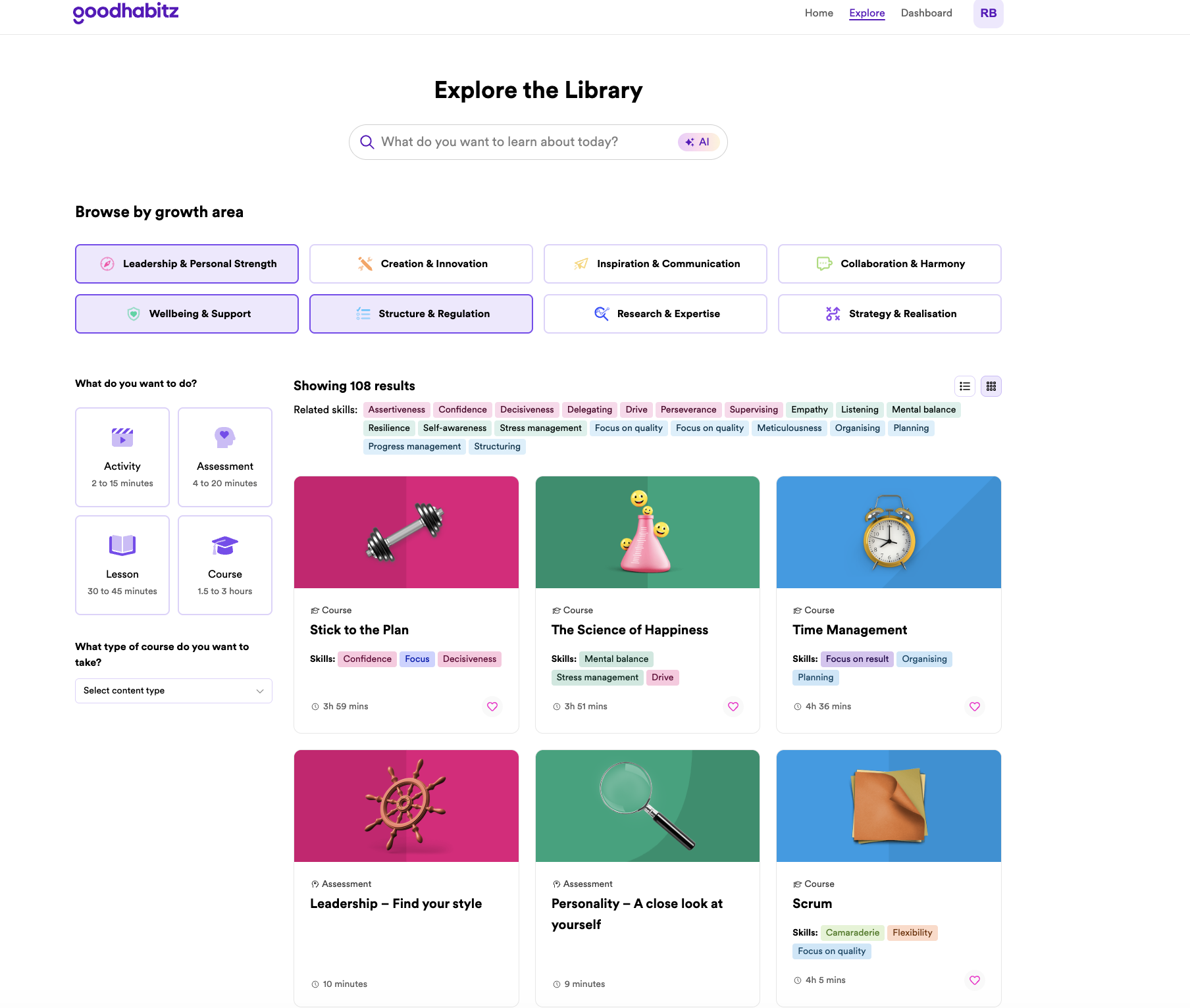
GoodHabitz is an online learning platform built specifically for employee development, with a content library focused on the skills that shape how people work: communication, leadership, resilience, collaboration, digital capability, and wellbeing. The platform covers more than 200 courses, all produced to broadcast quality in-house, and available across 15+ languages.
What distinguishes GoodHabitz from most competitors in the content library space is its engagement-first design. Courses aren't lecture-style video - they combine bite-sized activities, assessments, team exercises, podcasts, and reading formats, all designed to hold attention and get completed. The Talentscan tool helps employees identify which skills to focus on, and structured learning paths guide development rather than leaving employees to self-navigate a large catalogue.
The platform is designed to be used, not just deployed. That includes a dedicated customer success team focused on adoption outcomes, campaign tools built into the platform to promote learning internally, and onboarding support that goes beyond a setup guide.
Key features:
- 200+ courses across human skills, digital skills, and wellbeing
- 25+ learning formats per course (video, activities, assessments, podcasts, team exercises)
- Talentscan: personalised skill-gap identification tool
- 15+ languages with full localisation, not just subtitles
- Integrates with Workday, SAP SuccessFactors, Cornerstone, Moodle, and 360Learning, among others
- Dedicated customer success team focused on engagement and adoption
Pros:
- Consistently high engagement rates compared to traditional content libraries - content is designed to be completed, not abandoned
- Strong multilingual offering: content is fully localised, not machine-translated
- One fixed price for unlimited access to the full library - no per-course charges
- Excellent adoption support: more than a technical onboarding, with internal campaign tools and strategic guidance
Cons:
- Content is focused on soft skills and digital capability - not a fit for deep technical or compliance-heavy training needs
- Smaller overall library than volume-focused competitors like LinkedIn Learning or Udemy Business (intentional depth-over-breadth positioning, but worth noting)
- Pricing requires a conversation - no public rate card
Pricing:
Quote-based. Fixed annual subscription for unlimited access to the full library. Contact for a quote.
G2 rating:
4.6/5
2. LinkedIn Learning
Best for:
Broad professional upskilling where LinkedIn profile integration and certificate visibility matter
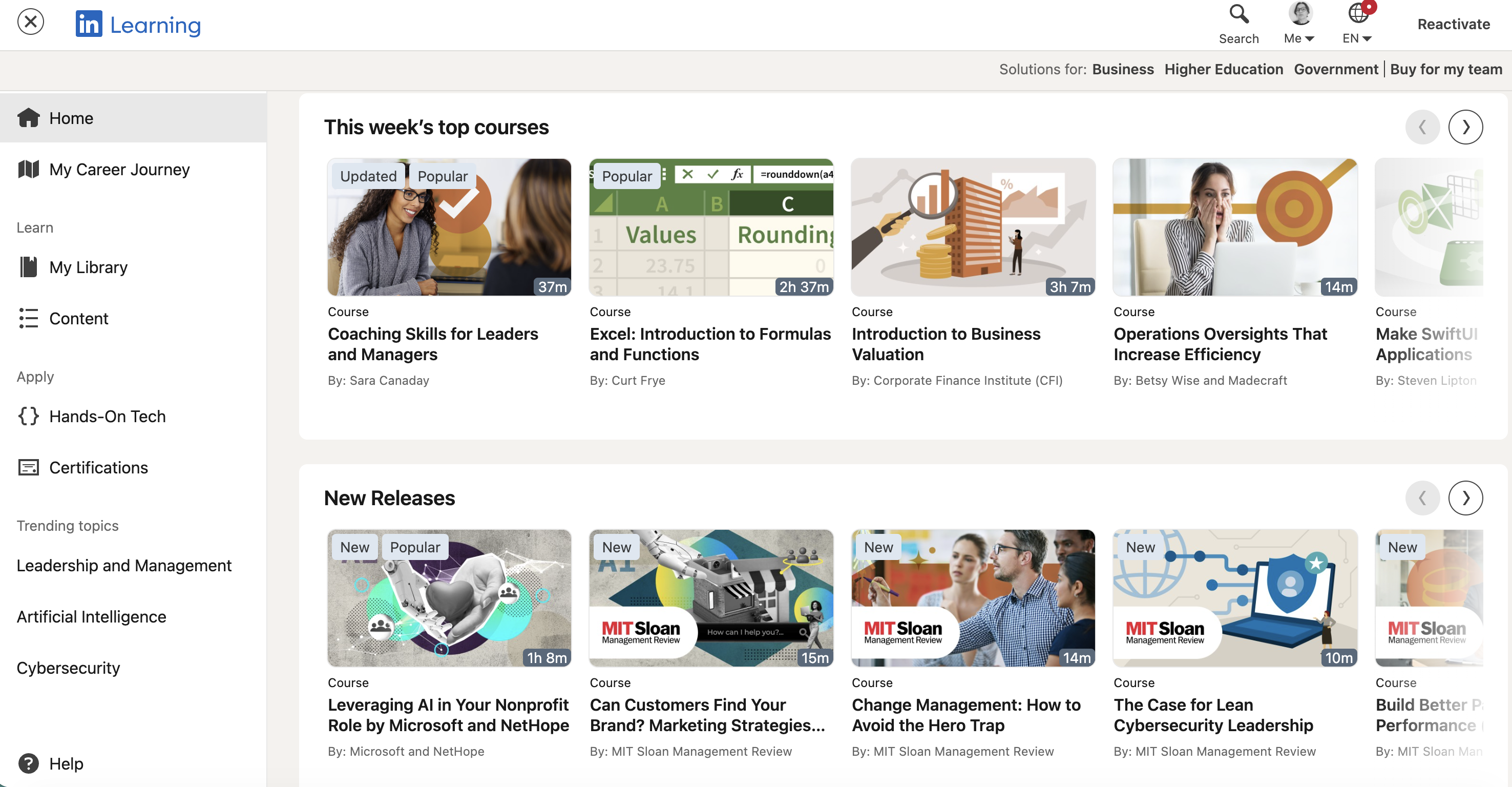
LinkedIn Learning is one of the largest online learning platforms in the world, with over 25,000 expert-led courses across business, technology, and creative skills. Its integration with the LinkedIn platform is its defining differentiator: completed courses and certificates appear directly on employee profiles, which has genuine value for motivated learners who want visible professional development.
For L&D teams, the platform offers admin dashboards, learning paths, and AI-powered course recommendations. It's easy to deploy, works on mobile, and provides enough breadth to serve most general upskilling needs. The soft skills catalogue - communication, leadership, management, productivity - is substantial, though depth varies by topic.
Key features:
- 25,000+ courses; one of the largest libraries on the market
- LinkedIn profile integration - certificates appear on employees' profiles
- AI-powered personalised recommendations based on skills and career goals
- Learning paths and admin-assigned content
- Integrations with major HRIS and LMS platforms
Pros:
- Exceptional breadth - covers almost any professional development topic
- Profile integration drives intrinsic motivation for career-focused learners
- Familiar interface reduces adoption friction
- Regular content updates, especially for fast-moving topics like AI
Cons:
- Content quality varies - some courses are excellent, others feel dated or surface-level
- Passive, video-heavy format: lower completion rates than more interactive platforms
- Soft skills content doesn't always translate to behaviour change - knowledge without practice
- Less effective for learners not motivated by LinkedIn career visibility
Pricing:
Teams: approximately £380/user/year (around $399 USD). Enterprise: quote-based. Note: pricing varies significantly by region and contract size.
G2 rating:
4.4/5
3. Coursera for Business
Best for:
Organisations where credentials and academic-grade content carry weight internally or externally
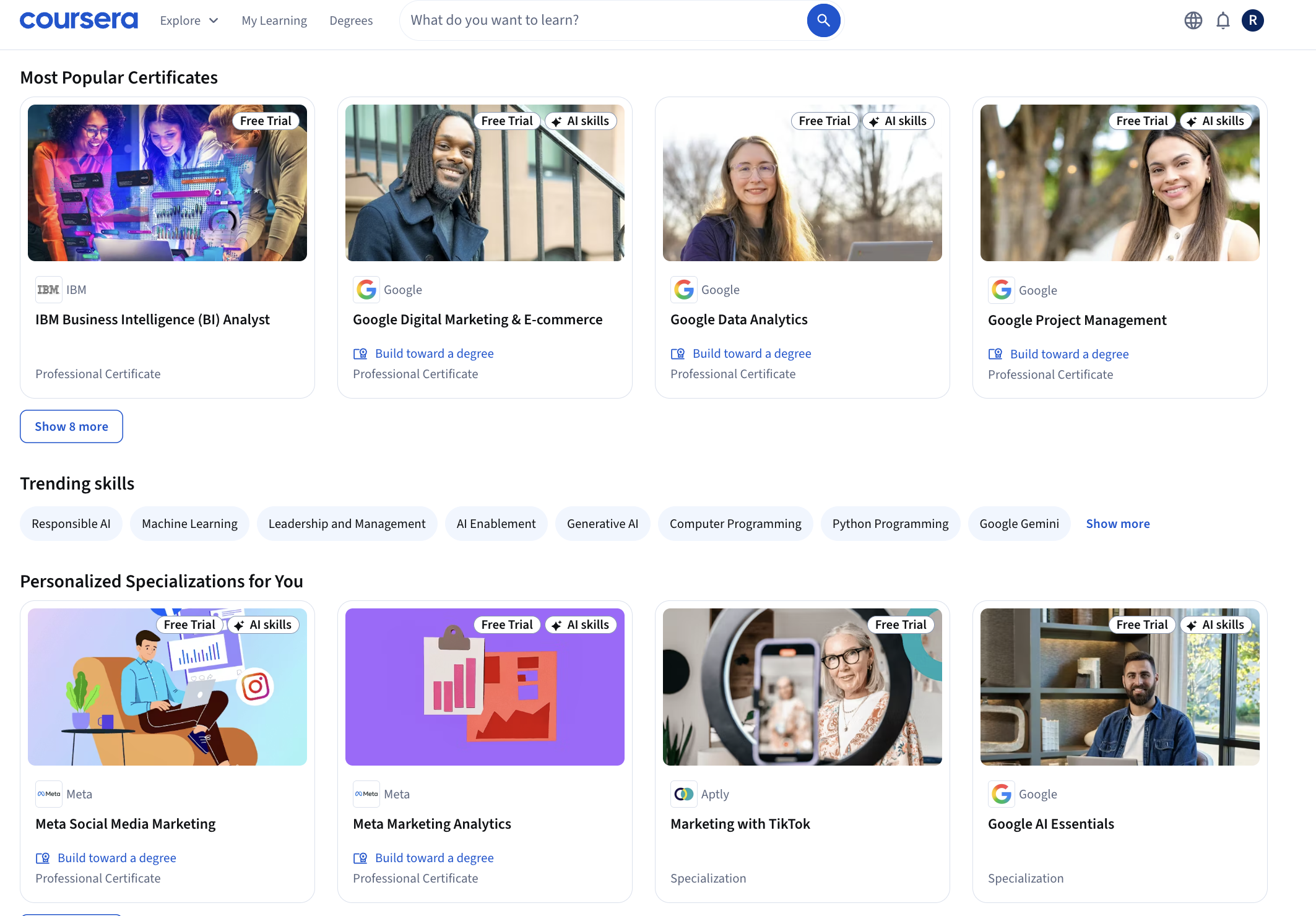
Coursera for Business provides access to content from over 325 universities and industry partners - Google, IBM, Meta, Johns Hopkins, and others. The platform's core proposition is credential-backed learning: courses come with professional certificates from recognisable institutions, which carries weight in industries where qualifications matter.
The soft skills offering spans leadership, management, communication, and professional development, though the platform's strongest content tends to be in technical and digital skills. The admin layer is capable: learning paths, AI-driven skill gap analysis, and progress tracking across teams. Completion rates tend to be higher than pure video platforms thanks to structured assignments and peer-review components.
Key features:
- Content from 325+ universities and companies including Google, IBM, and Meta
- Professional certificates included in the Teams/Enterprise subscription
- AI-powered learning path builder and skill gap identification
- Peer-reviewed assessments for structured courses
- SSO, HRIS integrations, and custom learning paths for enterprise
Pros:
- Credential quality: certificates from recognised institutions add genuine external value
- Strong content for technical and digital upskilling alongside soft skills
- Good completion rates driven by structured course design
- Suits organisations in professional services, consulting, finance, and education where credentials are culturally valued
Cons:
- Some courses feel academic and theoretical - not always applied to real workplace contexts
- Peer-review components can slow down completion and frustrate learners on tight schedules
- Degree-level pathways (MBAs, MScs) are priced separately and can be expensive
- Less suited to organisations where credentials are irrelevant and speed of learning matters more
Pricing:
Teams (5–499 users): ~$399/user/year. Enterprise: quote-based (~$300–500/user/year based on volume and contract length).
G2 rating:
4.5/5
4. Udemy Business
Best for:
Teams that need broad course access at volume across technical and business skills
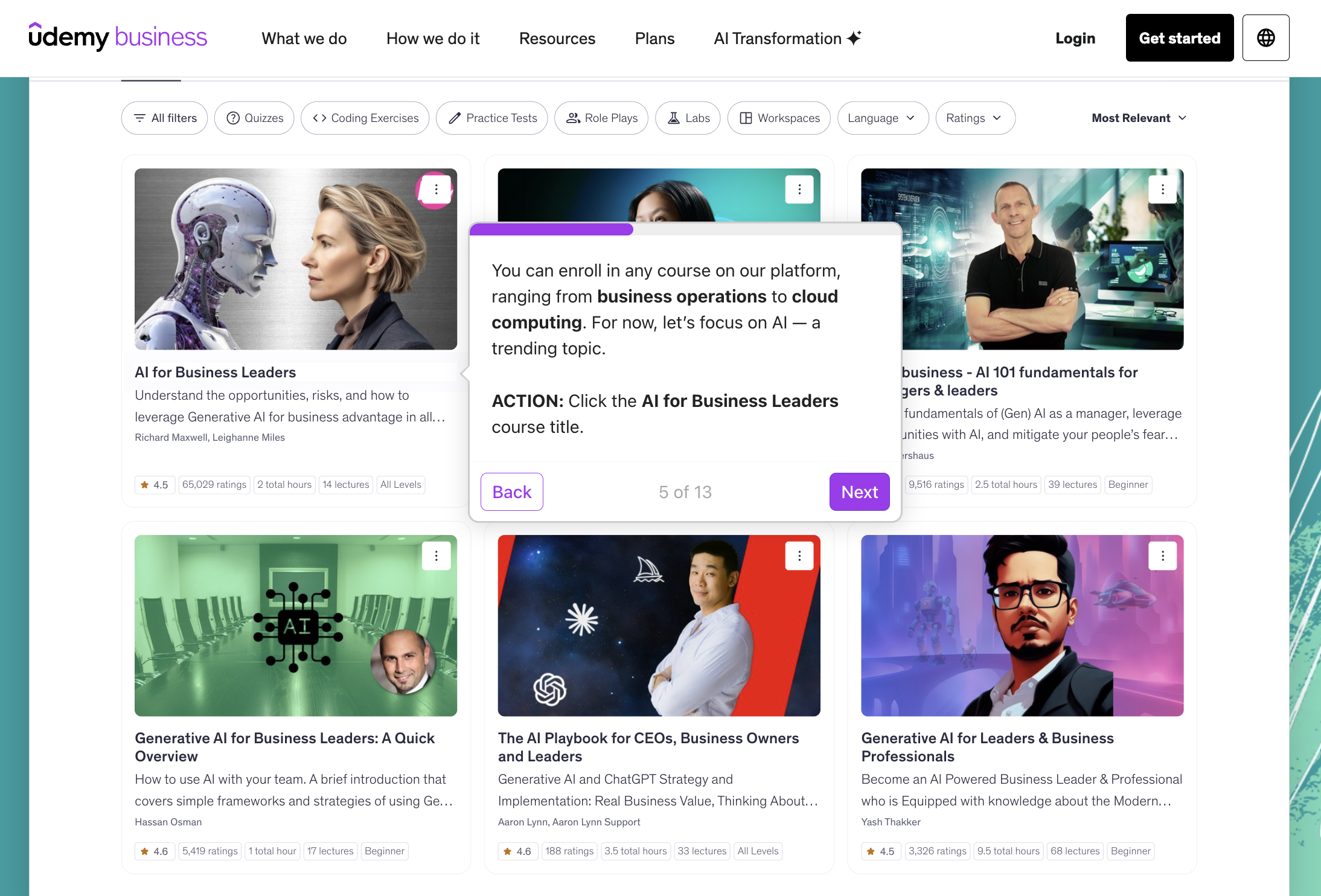
Udemy Business gives organisations access to a curated selection of over 27,000 courses from Udemy's marketplace of instructor-created content. The platform covers a wide range from technical skills (programming, data, cloud) to business and soft skills (leadership, communication, project management) and is particularly strong for mixed-skill organisations where one platform needs to serve very different teams.
The value proposition is volume and variety at a competitive price point. Udemy Business also offers admin tools for learning path assignment, progress tracking, and reporting. More recently, AI roleplay features have been added that allow learners to practise communication scenarios - a genuine improvement for soft skills application.
Key features:
- 27,000+ curated courses across technical, business, and soft skills
- Learning paths and course assignment for teams
- AI-powered GenAI roleplay tool for communication and decision-making practice
- Mobile learning with offline access
- Integrations with major LMS, HRIS, and SSO systems
Pros:
- Exceptional breadth - something for almost every team and role
- Competitive pricing relative to competitors at a similar volume
- Technical content is strong, making it a good fit for mixed tech/business teams
- New GenAI roleplay features add applied practice to what was a passive video experience
Cons:
- Course quality varies significantly: content is instructor-created, not editorially controlled, and some is outdated
- Soft skills content in particular can be repetitive or surface-level across multiple courses
- Certificates are not widely recognised externally
- Less suited to organisations where content quality and consistency are priorities over volume
Pricing:
Quote-based for teams and enterprise. Individual plans start around $30/user/month.
G2 rating:
4.5/5
5. Skillsoft (Percipio)
Best for:
Large enterprises that need to manage compliance training and leadership development in a single system
Skillsoft delivers learning through its Percipio platform - a learning experience platform combining a large content library with structured learning paths (Aspire Journeys), skill benchmarking, and an admin layer designed for enterprise deployment. The content covers leadership, business skills, compliance, and technology, making it a broad-coverage option for organisations that need one system to serve multiple training mandates.
The platform's skill benchmarking feature is a genuine differentiator: it lets L&D teams and employees assess current capability levels and track progress over time, which goes beyond simple completion tracking. Customer support is consistently rated highly, and enterprise integrations with Workday, SAP SuccessFactors, and others are mature.
Key features:
- Large content library spanning leadership, compliance, business skills, and technology
- Aspire Journeys: guided learning paths aligned to career goals
- Skill benchmarking: assess current capability and track progression
- Leadership development add-ons including live coaching and scenario-based content
- Strong enterprise integrations and SSO
Pros:
- Broad content coverage in a single system - useful for organisations that want one vendor for compliance, leadership, and general skills
- Skill benchmarking adds measurability beyond completion rates
- Responsive customer support, consistently rated above industry average
- Mature enterprise infrastructure - governance, permissions, multi-region support
Cons:
- Pricing sits at the higher end, and can feel expensive for smaller organisations
- Interface can feel complex, particularly for non-technical administrators
- Mobile experience less polished than consumer-grade competitors
- Value is strongest when organisations use Skillsoft's own content - less compelling if you already have other content libraries
Pricing:
Quote-based. Enterprise deployments typically ~$200–500/user/year based on Vendr transaction data.
G2 rating:
4.1/5 (Percipio platform)
6. BetterUp
Best for:
Large enterprises investing in leadership development and workforce resilience through structured coaching
BetterUp is the market leader in enterprise coaching platforms. It connects employees with ICF-certified coaches through a combination of 1:1 live coaching sessions, AI coaching tools, and science-backed assessments. The platform is built on a 'Whole Person Model' - developing not just professional skills but mindset, resilience, and wellbeing, with the claim of a 14x ROI and measurable behavioural outcomes.
BetterUp offers four product lines targeting different populations: Lead (executives), Manage (managers), Grow (all employees via AI coaching), and Ready (resilience for workforce change). The breadth makes it one of the few coaching vendors that can serve an entire organisation at different levels, though cost increases significantly as coverage expands.
Key features:
- 4,000+ ICF-certified coaches across multiple geographies and languages
- Human coaching + AI coaching (BetterUp Grow) for scalable access
- Whole Person assessments: science-backed tools to identify development focus areas
- Aggregated insights for HR teams: anonymised trends across coaching populations
- FedRAMP certified for public sector and security-sensitive deployments
Pros:
- Largest certified coach network in the market - strong for distributed, global organisations
- Proven behaviour change model with published research and client case studies
- AI coaching layer (Grow) makes coaching access more scalable and affordable
- Well-established brand with Fortune 500 client base - easier internal buy-in for the investment
Cons:
- Pricing is at the premium end and can be a significant multiple of content library alternatives
- Coaching framework is BetterUp's own - less flexibility to align to your specific competency framework
- Managers are not typically in the loop on coaching conversations, which limits visibility
- Limited to 3 coach options per user initially, with no free first-session trial
Pricing:
Quote-based. Per-seat coaching plans typically in the $300–1,000+/user/year range based on tier and volume.
G2 rating:
4.6/5
7. Torch
Best for:
Mid-market and enterprise organisations running structured leadership coaching programmes tied to specific competencies
Torch is an integrated coaching and mentoring platform designed specifically for L&D leaders building structured leadership development programmes. Unlike larger coaching marketplaces, Torch aligns its coaching and group learning directly to the organisation's own values, competencies, and strategic goals - making it more configurable than BetterUp for organisations that have a defined leadership framework they want to reinforce.
The platform combines 1:1 coaching, group cohort learning, and mentoring in a single system. Reporting and assessments go beyond participant satisfaction to measure behaviour change - a meaningful differentiator for L&D teams that need to demonstrate ROI. Coaches are vetted for quality and reviewers consistently rate coach calibre as a strength.
Key features:
- Integrated coaching, group learning, and mentoring in one platform
- Configurable to company-specific competency frameworks and values
- Behaviour-change assessments that go beyond satisfaction surveys
- Vetting process for coaches with emphasis on calibre over scale
- Admin tools for programme management and reporting
Pros:
- Strong alignment to company-specific goals - coaching doesn't exist in isolation from the business
- Combining coaching and mentoring in one system reduces vendor sprawl
- Assessments measure actual behaviour change, not just whether people enjoyed the sessions
- Highly rated customer support and strategic partnership approach
Cons:
- Smaller coach network than BetterUp - less suited to very large or highly distributed organisations
- Platform interface has received some criticism for complexity, though recent updates have improved this
- No public pricing or self-serve access - requires a sales conversation for any evaluation
- Less suited as a standalone solution for broad workforce development
Pricing:
Quote-based. No public pricing.
G2 rating:
4.5/5
8. Pluralsight
Best for:
Technology teams that also need access to professional and communication skills alongside technical content
Pluralsight is primarily a technology skills platform - built for software developers, cloud engineers, cybersecurity teams, and data professionals. Its soft skills offering exists alongside, not at the centre of, a catalogue of 6,500+ technical courses. For L&D teams supporting predominantly technical workforces, Pluralsight's appeal is consolidation: one platform for both technical upskilling and the professional skills that tech teams also need.
The platform's Skill IQ assessments objectively measure capability in specific areas, and hands-on labs provide applied practice for technical skills. The business and professional skills catalogue - communication, leadership, project management - is functional but thinner than specialist alternatives. For organisations whose primary challenge is technical skills, this is the right trade-off.
Key features:
- 6,500+ courses with emphasis on cloud, DevOps, security, data, and software development
- Skill IQ assessments: objective capability measurement across technical domains
- Hands-on labs and sandboxes for applied technical practice
- Role IQ: team-level skills benchmarking against role requirements
- Enterprise plan includes SSO, advanced analytics, and API access
Pros:
- The strongest platform on the market for technical skill development - the depth of content in cloud, security, and dev is unmatched
- Skill IQ gives L&D teams objective data on team capability, not just completion counts
- Consolidation value for tech-heavy organisations that don't want separate platforms
- Strong enterprise infrastructure and integrations
Cons:
- Soft skills content is secondary - limited depth in communication, leadership, and behavioural skills
- Primarily a platform for technically motivated learners; engagement for non-technical employees tends to be low
- Not the right primary choice for organisations whose soft skills challenge spans the whole workforce
- No refund on individual subscriptions; pricing complexity at enterprise scale
Pricing:
Individual plans from ~$299/year (Standard). Teams: quote-based. Enterprise: quote-based (~$399–565+/user/year).
G2 rating:
4.6/5
9. Degreed
Best for:
Large enterprises that want to connect all their existing learning to a skills intelligence layer
Degreed is a learning experience platform (LXP) - a fundamentally different category from the content libraries and coaching platforms in this list. It doesn't create or host content; it aggregates learning from across all your existing systems (your LMS, LinkedIn Learning, Coursera, YouTube, internal resources) and surfaces it through a skills-first interface. Employees see their skill profile, identify gaps, and receive personalised recommendations from everything your organisation has - not just from one vendor's catalogue.
For large enterprises already managing multiple content providers and learning systems, Degreed's intelligence layer can add significant value: connecting scattered learning data into a single view, mapping it to workforce skills, and supporting internal mobility. It's used by one in three Fortune 50 companies. It is not, however, a solution for organisations that don't already have significant content infrastructure to aggregate.
Key features:
- Aggregates content from 70+ integrated learning providers and internal systems
- Skills graph: maps all learning activity to skills, providing a workforce-level view of capability
- Personalised learning feed based on skill gaps, interests, and career goals
- Internal mobility tools: connects skill development to career pathways and internal opportunities
- Advanced analytics on skills supply and demand across the organisation
Pros:
- The only platform that gives a genuine organisation-wide view of skill development across all providers
- Strong internal mobility features - useful for talent strategy beyond L&D
- Integrates with 70+ tools, reducing the need to replace existing investments
- Endorsed by Fortune 50 companies with mature L&D functions
Cons:
- Not a content platform - if your content libraries are weak, Degreed won't fix that
- Requires significant implementation maturity: HR data, IT involvement, and L&D resource to configure and maintain
- Enterprise-only pricing, typically suited to organisations with 5,000+ employees
- Months-long implementation; not a fast-deployment solution
Pricing:
Quote-based. Enterprise-only, no public pricing. Requires a sales conversation.
G2 rating:
4.3/5
10. 360Learning
Best for:
Organisations that want to mobilise internal experts to create and share learning at scale
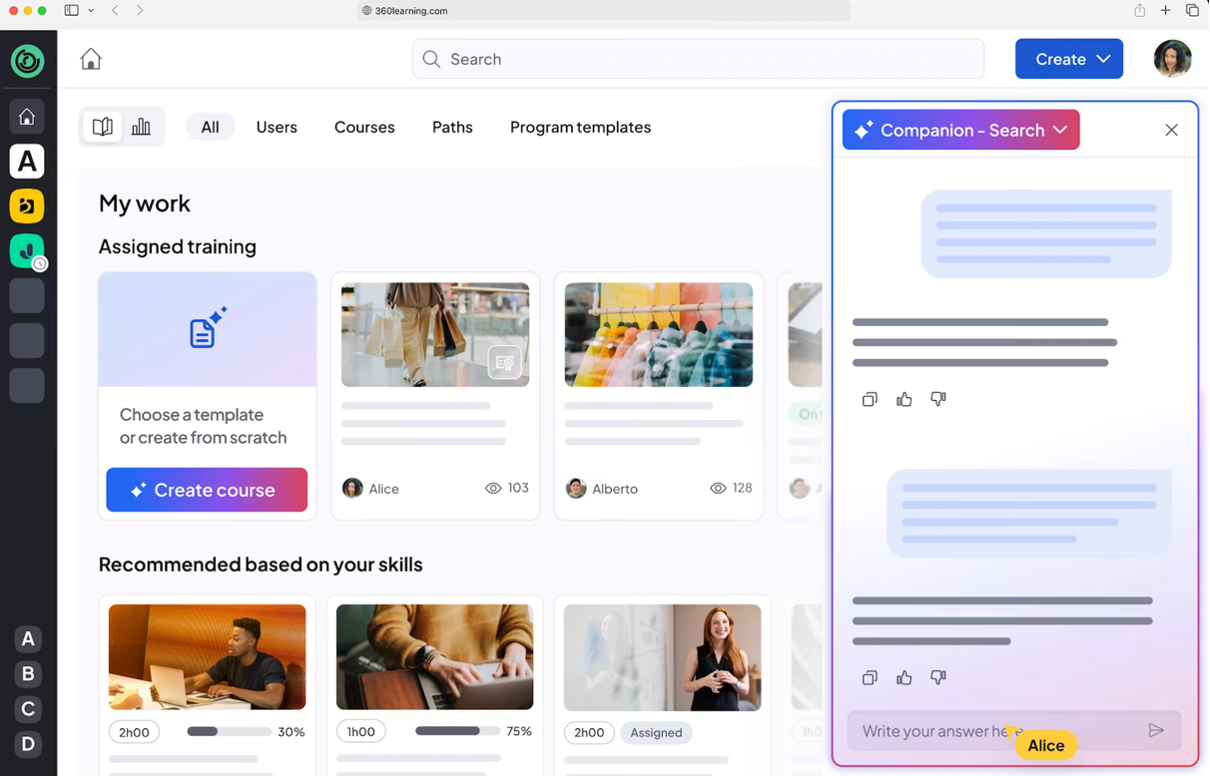
360Learning is an AI-powered collaborative LMS built on a distinctive premise: the best soft skills training doesn't come from external course catalogues - it comes from your own people. The platform enables subject matter experts within the organisation to create structured learning quickly, share it with peers, and iterate based on social feedback. It combines LMS functionality (course delivery, completion tracking, SCORM support) with LXP-style engagement features (comments, reactions, peer input on courses).
For L&D teams whose challenge is capturing and scaling internal expertise - onboarding processes, role-specific knowledge, internal practices - 360Learning is a strong fit. The AI tools accelerate content creation significantly. The collaborative learning model tends to produce higher engagement than passive external content because learners recognise the context and the people who created it.
Key features:
- AI-powered course authoring that helps subject matter experts build content quickly
- Collaborative learning features: comments, reactions, and peer feedback on courses
- Academies: structured, cohort-based learning programmes for strategic skills
- Skill mapping connected to learning content and career development
- 50+ integrations including Workday, BambooHR, Microsoft Teams, and LinkedIn Learning
Pros:
- The strongest fit for organisations that want to create internal training, not just buy external content
- Collaborative model drives higher completion and engagement rates
- Transparent pricing at the team level - one of the few platforms with a public rate card
- AI authoring tools significantly reduce the time-to-create for internal courses
Cons:
- Content quality depends on internal experts - the platform is only as good as the knowledge your people are willing to contribute
- Less suited for organisations with little internal expertise to capture, or who primarily need access to an external content library
- Advanced customisation and enterprise features require Business or Enterprise plans at custom pricing
- Some admin functions have a learning curve, particularly for complex group structures
Pricing:
Team plan: $8/user/month (up to 100 users, published). Business and Enterprise: quote-based.
G2 rating:
4.6/5
How to implement soft skills training successfully
Choosing the right platform is only half the job. The other half is making sure it gets used. A few principles that separate organisations that see real impact from those that don't.
Align with business goals before you launch
Soft skills training that isn't connected to a business outcome is treated as optional. Connect your programme to something the organisation is actively trying to achieve - faster onboarding, lower attrition, stronger manager effectiveness scores - and you'll find it much easier to get leadership buy-in and employee engagement.
Involve managers early
Managers are the single biggest driver of whether employees use learning platforms. If managers don't reference the training, don't follow up, and don't model the behaviours themselves, adoption will be low regardless of platform quality. Brief managers on what you're launching and why and give them simple ways to integrate it into team conversations.
Build habits, not campaigns
A launch event generates a spike in usage. Sustained habits are what produce outcomes. Think about how to make learning a regular, low-friction part of how people work - not a one-time push.
The platforms with the best adoption rates tend to be the ones integrated into existing workflows: inside Teams or Slack, embedded in onboarding, connected to performance reviews.
For a deeper look at building a learning culture that actually sticks, see our guide on how to choose an online learning platform for your organisation.
Conclusion: which platform is right for you?
The right platform depends on who you're developing, what behaviour you want to change, and what your organisation can realistically sustain.
- Small and growing teams - prioritise ease of deployment and low admin overhead. A ready-made content platform with a straightforward subscription model will serve you better than a complex enterprise system that requires dedicated resources to manage.
- Enterprises focused on broad upskilling - scalability and engagement are the metrics that matter. Look for platforms built to drive sustained usage across large, distributed workforces - not just to provide access.
- Organisations investing in leadership development - a coaching-based approach will produce stronger behaviour change than a content library alone. Expect a higher per-person investment and a narrower initial audience.
Whatever your situation, the most common mistake is choosing a platform before the problem is clearly defined. Start there, and the right shortlist becomes much easier to build.
Ready to find the right platform?
Try 14 days for free to see how GoodHabitz fits your organisation's goals, or start an interactive demo to evaluate content quality and user experience firsthand.
Roberta is a multilingual content manager with 15+ years of experience creating clear, engaging content that connects. Her goal is to help companies communicate complex topics in a more human, accessible way. An eager explorer and curious foodie, she spends her free time discovering new places and cultures, whether around the corner or on the other side of the world.